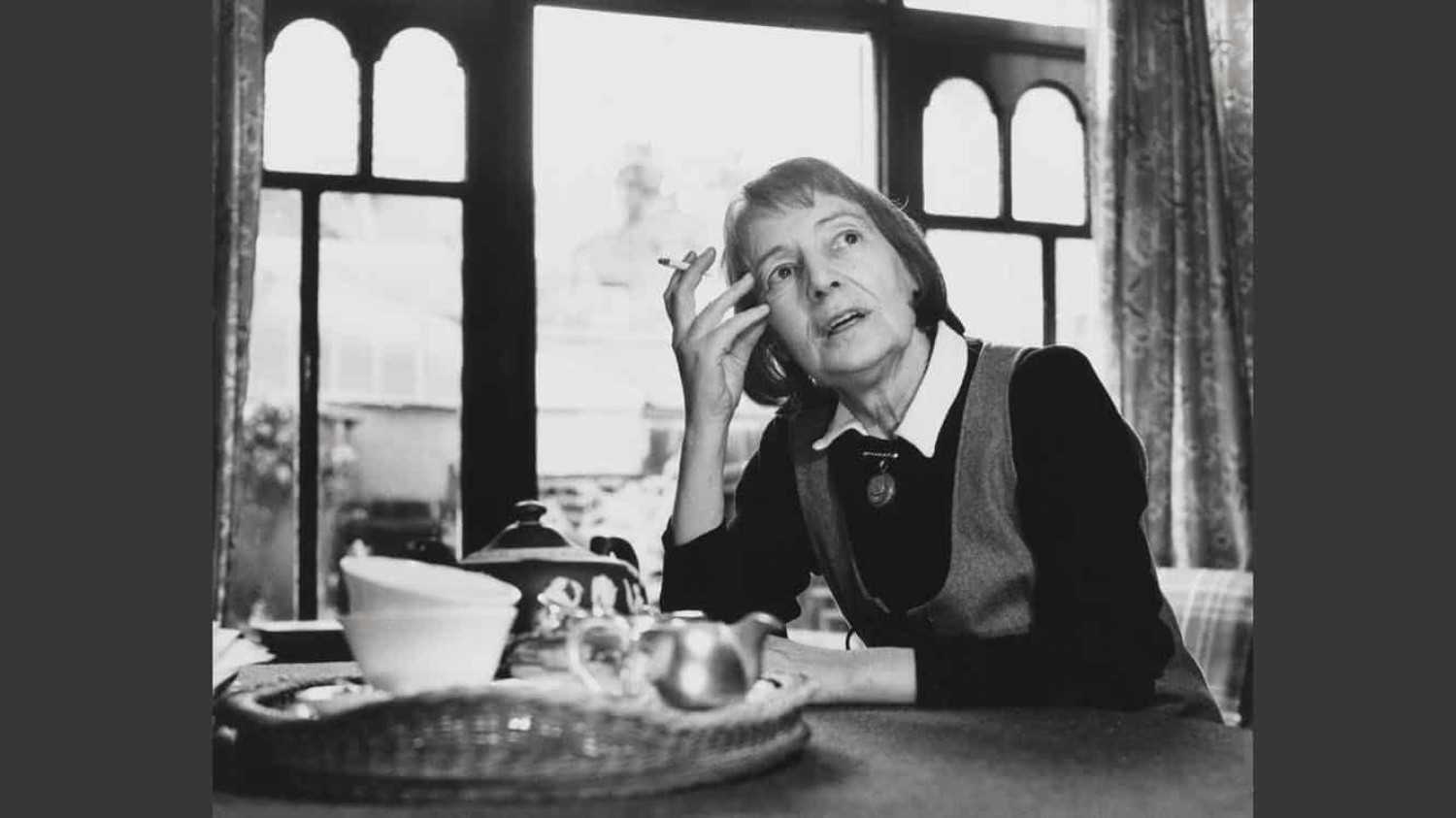
A biographical film, Stevie, about the life of British poet Stevie Smith, was produced in 1978. It stared Glenda Jackson. [1]
English poet and novelist Stevie Smith, whose real name was Florence Margaret Smith, died of a brain tumour on 7 March 1971, aged 68. She acquired the nickname “Stevie” in her youth, after a friend thought she resembled a well‑known jockey, Steve Donoghue. At the time of her death, she was living in the same London suburb house where she had spent much of her adult life.
Smith spent three decades (1923–1953) working as a secretary in the London offices of a magazine publisher. During those years she steadily developed the distinctive voice that would mark her as poet, novelist, reviewer, illustrator and performer. After leaving office life in the early 1950s, she lived and worked from her home in Palmers Green, where she cared for the elderly aunt who had raised her until the aunt’s death at ninety-six in 1968.
Her creative life was remarkably varied. Smith wrote three novels – all lightly fictionalised portraits of her own experience, sometimes to the discomfort of those who recognised themselves. The first, Novel on Yellow Paper (1936), introduced her playful, conversational style. Her poetry, however, secured her lasting reputation. She published numerous collections, often accompanied by her own idiosyncratic line drawings, and explored themes of death, loneliness, war, cruelty, religion, and the oddities of middle-class life. Her work is celebrated for its blend of apparent simplicity with sharp wit, emotional candour, and an unsentimental, often visionary outlook.
By the 1960s she had become a popular reader of her own poems, giving public recitals and making radio broadcasts and recordings. Although she also wrote short stories, reviews, and essays, she is chiefly remembered for her poetry, with “Not Waving but Drowning” becoming one of the most anthologised poems of the twentieth century. Its spare lines and haunting irony exemplify her unique voice.
Smith’s posthumous reputation has continued to rise. Her final collection, Scorpion and Other Poems, appeared in 1972, followed by a comprehensive Collected Poems in 1975, confirming her distinctive and original place in modern British literature.
Stevie Smith’s ashes were scattered in the Torquay Cemetery and Crematorium.