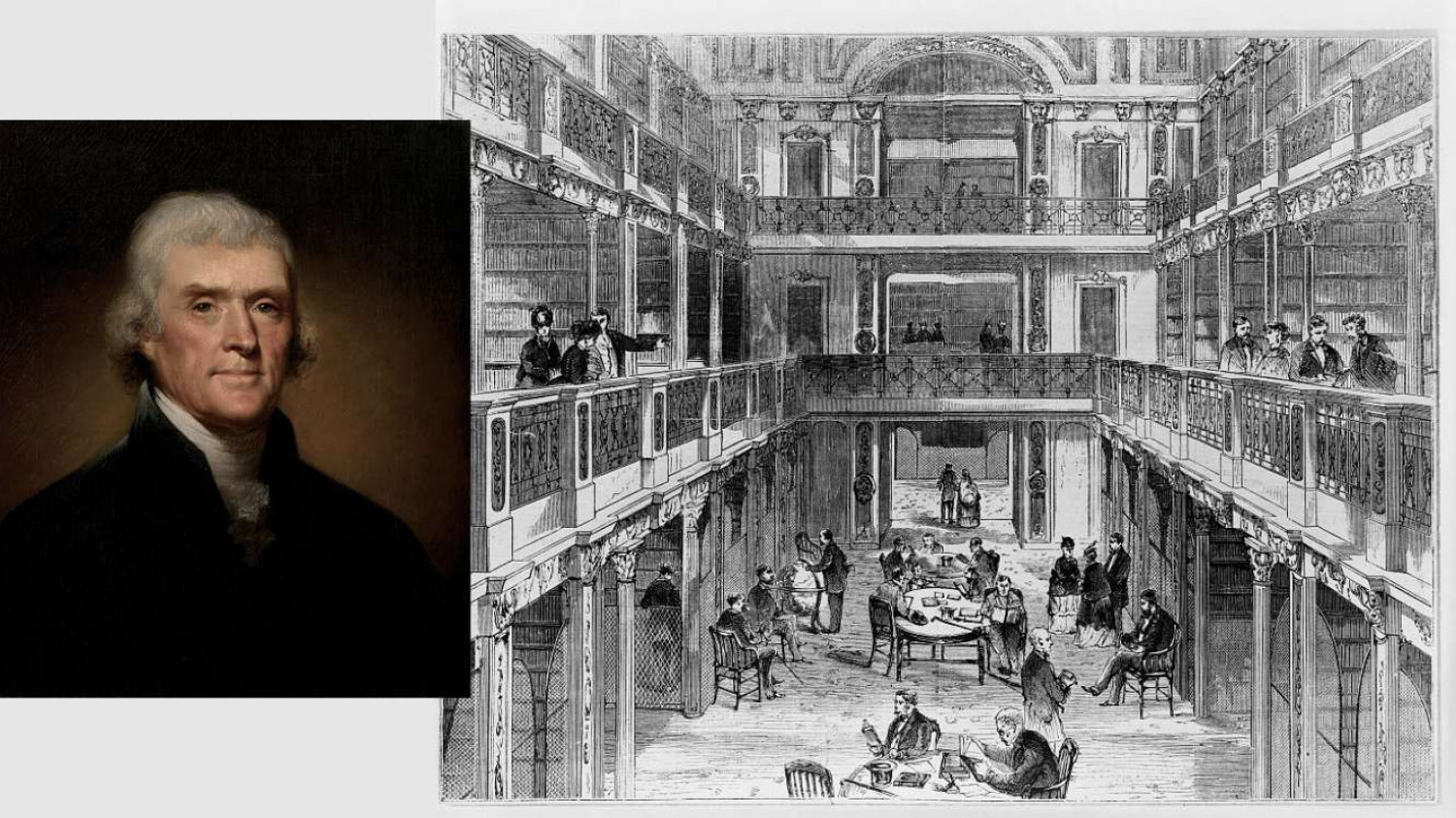
When Thomas Jefferson offered his library for sale, he did not name his price; instead, he allowed Congress to determine what it would pay him. Congress accepted and set a price of $23,950 for the 6,487 volumes. [1]
Thomas Jefferson was one of the most driven figures of the early American republic. The former president, principal author of the US Declaration of Independence, and lifelong scholar, had assembled a personal library of 6,487 volumes, covering subjects as diverse as philosophy, history, science, law, literature, architecture, music, and agriculture. It was the largest private book collection in North America.
By 1815, Jefferson was living in retirement at Monticello—financially strained, yet intellectually active—surrounded by the books that had shaped his career and private life.
The US Library of Congress was founded in 1800, making it the oldest federal cultural institution in the country. On 24 August 1814, British troops marched into Washington and burned several public buildings, including the Capitol, where the Library was housed. Its core collection of approximately 3,000 volumes—intended primarily as a reference library for members of Congress—was completely destroyed.
In the aftermath of this disaster, Jefferson made an offer. On 21 September 1814, he wrote to the Library Committee of Congress proposing the sale of his entire library to “recommence” the national collection. He explained that he had spent fifty years building it, sparing no effort or expense, and argued for its practical value to legislators. As he observed, “there is, in fact, no subject to which a member may not have occasion to refer.”
The proposal was not universally welcomed. Some members of Congress questioned the cost and the breadth of subjects included. After considerable debate, the House of Representatives approved the purchase by a narrow vote of 71 to 61 on 16 January 1815. James Madison, then president, formally approved the transaction on 30 January 1815. Congress paid $23,950 for the collection.
In May 1815, Jefferson’s volumes were transported by horse-drawn wagons from Monticello to Washington, carefully wrapped and reshelved in his original pine bookcases. They became the foundation of a renewed Library of Congress. Although a later fire in 1851 destroyed much of this collection, Jefferson’s vision endured: a national library defined by intellectual range, democratic purpose, and faith in knowledge as the bedrock of a republic.
Selected links for relevant websites, books, movies, videos, and more. Some of these links lead to protected content on this website, learn more about that here.