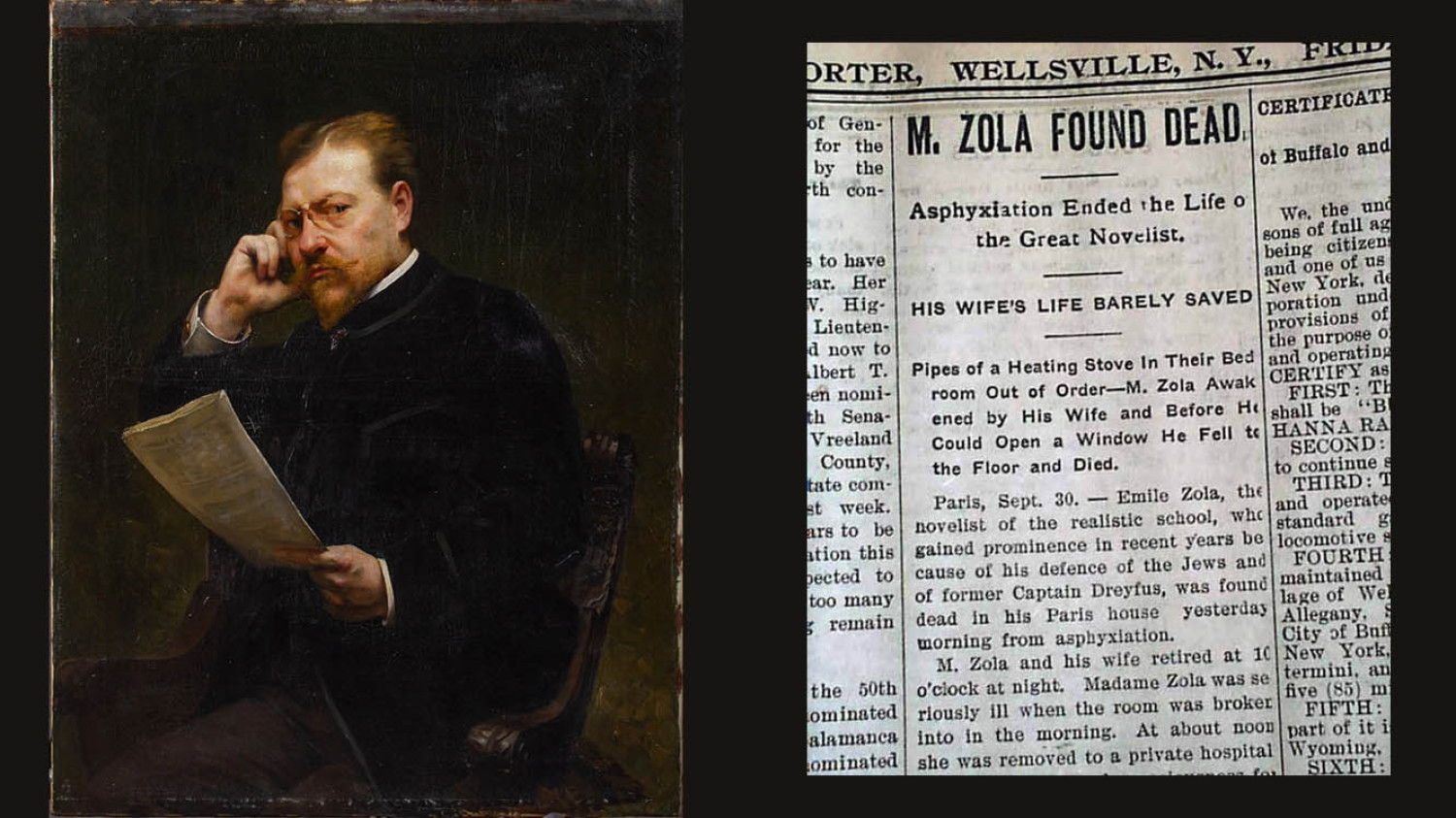
When Émile Zola died, rumours were rife that he had been murdered. An inquest was ordered and specialists conducted tests at the Paris house. Fires were lit and the flue was dismantled, but nothing of much significance was found, though the amount of soot suggested that the chimney had not been properly swept. [1]
Émile Zola, one of France’s most renowned writers had a life marked by both literary triumphs and great social involvement. He was nominated for the Nobel Prize in Literature in 1901 and 1902.
In the later years of his life, Zola’s focus shifted toward political activism, and his life was marked by both personal and public upheaval. The Dreyfus Affair left him politically estranged, and in 1898, he fled to England to avoid imprisonment for libel. He remained in London for a year before returning to France, where his notoriety continued to grow as the case unfolded.
On 29 September 1902, Émile Zola, aged 62, died at his home in Paris from carbon monoxide poisoning. On the morning of his death, at three in the morning, he and his wife awoke, feeling sick, but he stopped her rousing the servants. By daybreak she was discovered unconscious, and he was dead. Many found his death suspicious and suspected murder by the anti-Dreyfus movement. An inquest was ordered and tests conducted on the fireplaces, but nothing could be proven at the time.
His passing was marked by a public outpouring of grief and expressions of sympathy arrived from everywhere in France. For a week the vestibule of his house was crowded with notable writers, scientists, artists, and politicians who came to inscribe their names in the registers. His funeral on 5 October 1902 was attended by notable figures, including Alfred Dreyfus, whom Zola had famously defended during the Dreyfus Affair, and writer Anatole France, who delivered a eulogy praising Zola’s commitment to justice. An estimated 50,000 people attended his funeral procession to Montmartre Cemetery.
Zola’s remains were not left in the Montmartre Cemetery indefinitely. On 4 June 1908, just short of six years after his death, they were relocated to the Panthéon, where he shares a crypt with Victor Hugo and Alexandre Dumas.
Despite the controversy surrounding his death, Zola’s influence remains undeniable. His legacy as a writer, public figure, and moral advocate endures.
Selected links for relevant websites, books, movies, videos, and more. Some of these links may lead to protected content on this website, learn more about that here.