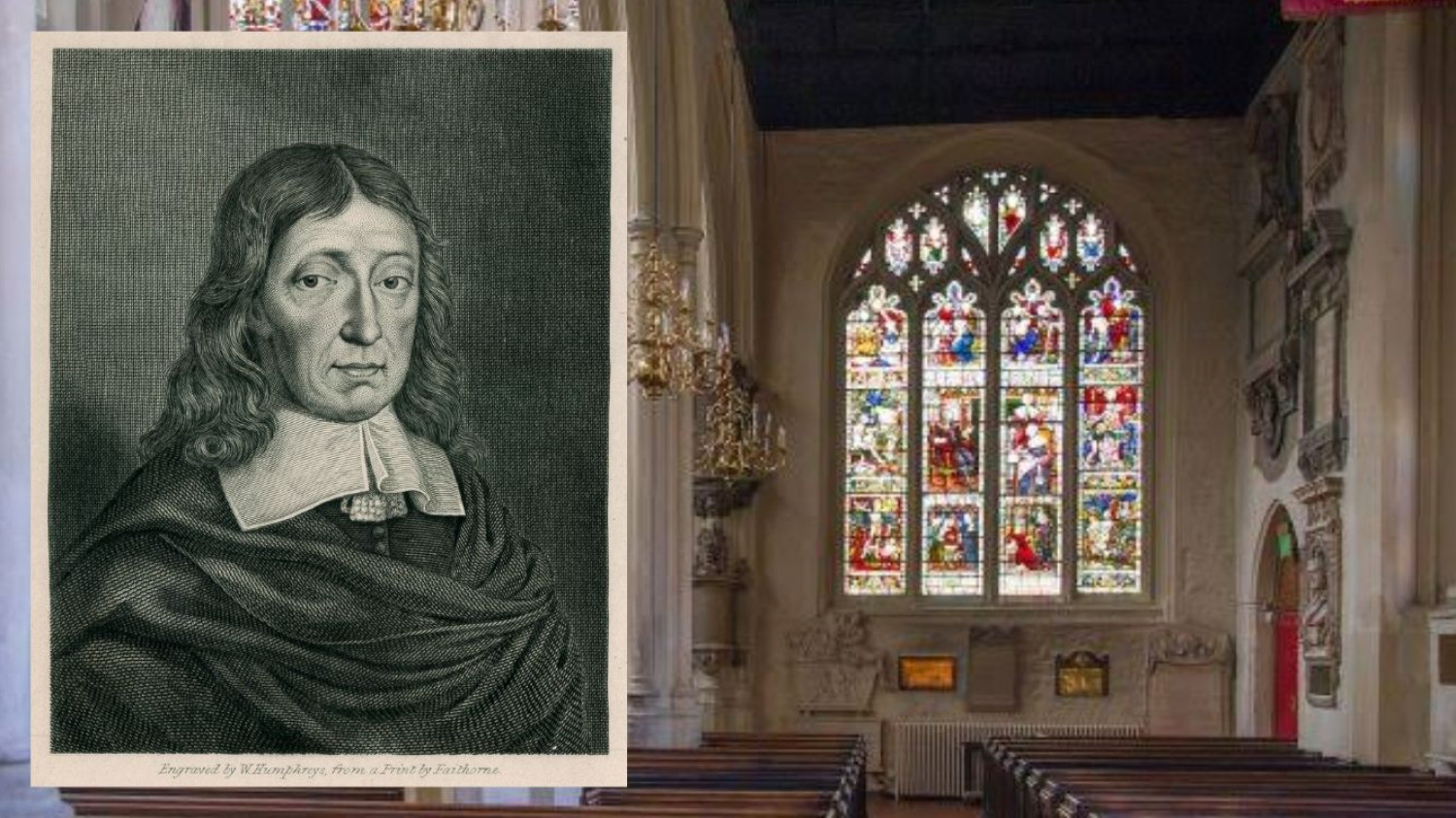
Robert Browning attended the unveiling of John Milton’s memorial window at St Margaret’s in 1888, and Matthew Arnold gave the address. [1]
On 12 November 1656, English poet John Milton married his second wife, Katherine Woodcock. Their brief marriage is remembered mainly because of a sonnet traditionally associated with her, ‘Methought I saw my late espoused saint’. In fourteen lines, the poet best known for Paradise Lost describes a dream of reunion with a dead wife, followed by the painful return to waking life.
Milton was forty-seven, already blind, and a widower with three young daughters. His first wife, Mary Powell, had died in 1652. At the time, Milton was living in Westminster and working as Latin Secretary to the Commonwealth, translating its official correspondence and writing forceful pamphlets in defence of the republic. The marriage is commonly thought to have taken place at St Margaret’s, Westminster, although it could have been a civil ceremony conducted by Sir John Dethicke, and its precise location is uncertain.
Little is known about Katherine herself. In October 1657 she gave birth to a daughter, also named Katherine, but she died the following February. The baby survived her by only a few weeks. Within fifteen months of his wedding, Milton was again a widower.
The sonnet linked to Katherine brings classical literature and Christian belief into a deeply personal poem. Milton compares the returning wife to Alcestis, rescued from death by Hercules in Greek mythology. Dressed in white, she approaches him with her face veiled. He imagines seeing her fully in heaven, but the hoped-for embrace never happens: “I wak’d, she fled, and day brought back my night.”
For a blind poet, that final reversal gives daylight an unusually painful meaning. Whether Milton was remembering Katherine or his first wife, Mary, remains debatable. But the sonnet’s grief is unmistakable. In just fourteen lines, the poet of Paradise Lost gives us something much more intimate: a dream of reunion and the pain of waking to find himself alone.
Selected links for relevant websites, books, movies, videos, and more. Some of these links lead to protected content on this website, learn more about that here.
Britannica: John Milton
WikiTree: Katherine Woodcock
Wikipedia: Mary Powell
Poetry Foundation: Methought I saw my late espoused saint
Paradise Lost by John Milton
Project Gutenberg: Paradise Lost by John Milton
Susannah Fullerton: John Milton John Milton sells the rights to Paradise Lost
Susannah Fullerton: John Milton & On his Blindness