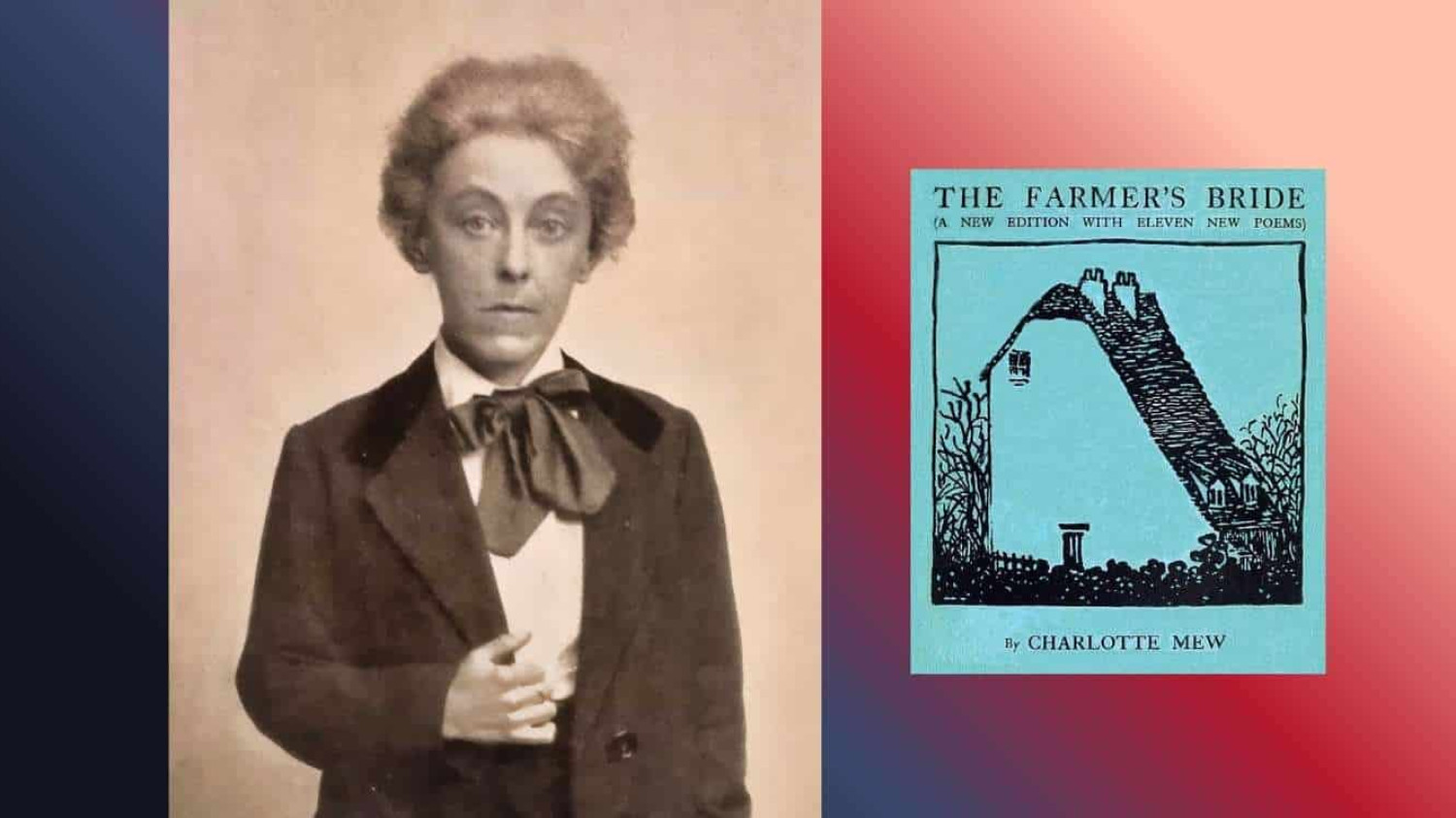
Charlotte Mew was a small, short-haired woman. Throughout her adult life she dressed in tailored men’s suits and always carried a black umbrella, cultivating a distinctive, dandy-like appearance. [1]
Charlotte Mary Mew was an English poet whose work spanned the eras of Victorian poetry and Modernism. She was born on 15 November 1869 in Bloomsbury, a district closely linked with London’s professional and literary circles. Charlotte was the second of seven children of Frederick Mew, an architect employed by the Bedford Estate, and his wife Ann, whose family had a successful tailoring business on the Isle of Wight. Although the household benefited from Frederick’s steady income, it was troubled by the ill health of several children, a circumstance that cast long shadows over Charlotte’s early years.
Much of her childhood was spent quietly at home, with education largely undertaken within the family. The atmosphere became still more subdued when two of her brothers were diagnosed with schizophrenia and later institutionalised, events that caused deep distress and heightened Charlotte’s awareness of fragility and loss — themes that would later surface in her writing.
Frederick Mew died in 1888, leaving inadequate financial provision for his family. Charlotte, her mother, and her sister Anne moved frequently between rented rooms and lived with marked frugality. Three of the Mew children had died young, and with two others in institutions, Charlotte and Anne formed a pact never to marry, fearing the inheritance of mental illness.
By the early 1890s she had begun to write prose sketches and poetry, exploring narrative voice and experimenting with form. Her first significant publication came in 1894, when her short story “Passed” appeared in The Yellow Book, reflecting her interest in marginal lives and social unease. Further contributions to magazines followed, though her poetic work developed more slowly. A breakthrough came in the 1910s and “The Farmer’s Bride” was published in 1912, displaying the dramatic tone, speech rhythms, and emotional restraint that became hallmarks of her style. Charlotte Mew’s work drew admiration from leading writers: Thomas Hardy considered her the best woman poet of her day, Virginia Woolf praised her originality, and Siegfried Sassoon championed her talent.
The death of Anne in 1927 was a devastating blow. Charlotte sank into severe depression and was admitted to a nursing home, where she died by suicide later that year. Her small but striking body of work remains a distinctive contribution to early twentieth-century poetry.
Selected links for relevant websites, books, movies, videos, and more. Some of these links lead to protected content on this website, learn more about that here.