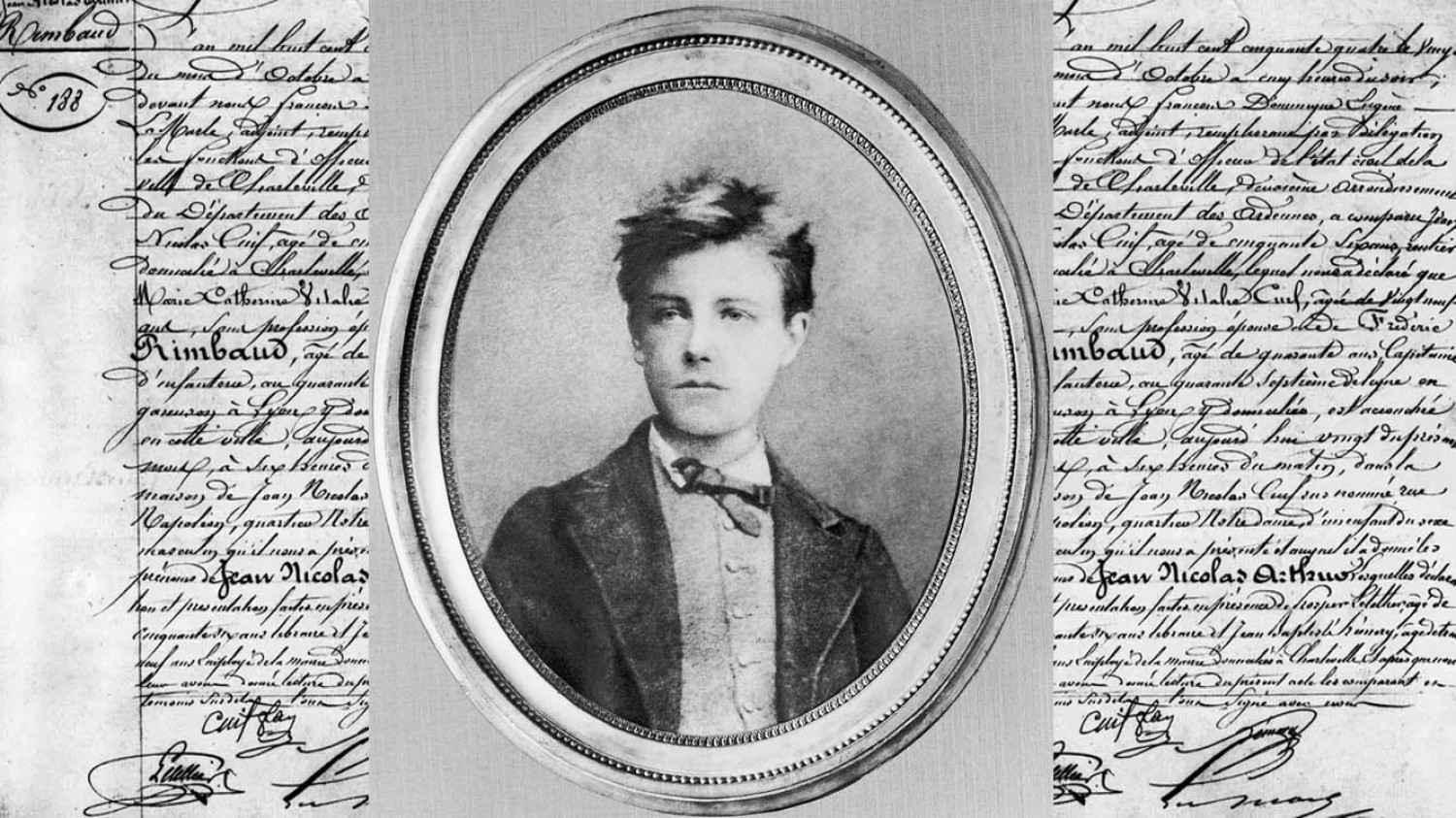
Arthur Rimbaud wrote all of his poetry in a span of only about five years, concluding around the year 1875. [1]
Arthur Rimbaud was born on 20 October 1854, in Charleville, northeastern France, to Frédéric and Vitalie Rimbaud. His father, a soldier who abandoned the family when Rimbaud was young, left his mother to raise Arthur and his siblings. This absence of a father figure shaped Rimbaud’s rebellious nature and unconventional worldview. His mother, strict and focused on education, pushed Rimbaud to excel academically. By the age of six, he was reading and writing, demonstrating a particular talent for languages and literature. At the lycée, he excelled and began writing poetry in his spare time.
Physically, Rimbaud was small and pale, with striking eyes described by his lifelong friend Ernest Delahaye as “pale blue irradiated with dark blue.” Though his early years were marked by academic discipline, his creative genius emerged in secret. By 16, Rimbaud was already writing some of his most famous, experimental poems, heavily influenced by Romanticism but rejecting traditional literary forms. His early works, written during his time at the lycée, reflect a desire to break free from societal, artistic, and literary norms.
His poems often explore themes of alienation and transcendence, blending youthful rebellion with creative brilliance. One of his most famous early works, Le Bateau Ivre (The Drunken Boat), written at 16, tells the story of a boat drifting aimlessly, symbolising Rimbaud’s escape from societal constraints. It conveys a sense of disillusionment and longing for freedom through hallucinatory images.
Rimbaud’s Premières poésies (First Poems), including Le Dormeur du Val (The Sleeper in the Valley), showcases his ability to blend beauty with violence. This poem contrasts innocence with death, making a stark statement on the brutality of war. In Une Saison en Enfer (A Season in Hell), written at 19, Rimbaud departs from traditional verse, using dark, symbolic imagery to explore his emotional turmoil and rebellion, solidifying his desire to push poetic boundaries and challenge conventional expression. His early works not only showcased his immense talent but also foreshadowed the modernist movements that would follow.
After giving up poetry before he was 20, Rimbaud then travelled and led a restless life before dying from cancer just before his 37th birthday in November 1891.
Selected links for relevant websites, books, movies, videos, and more. Some of these links lead to protected content on this website, learn more about that here.