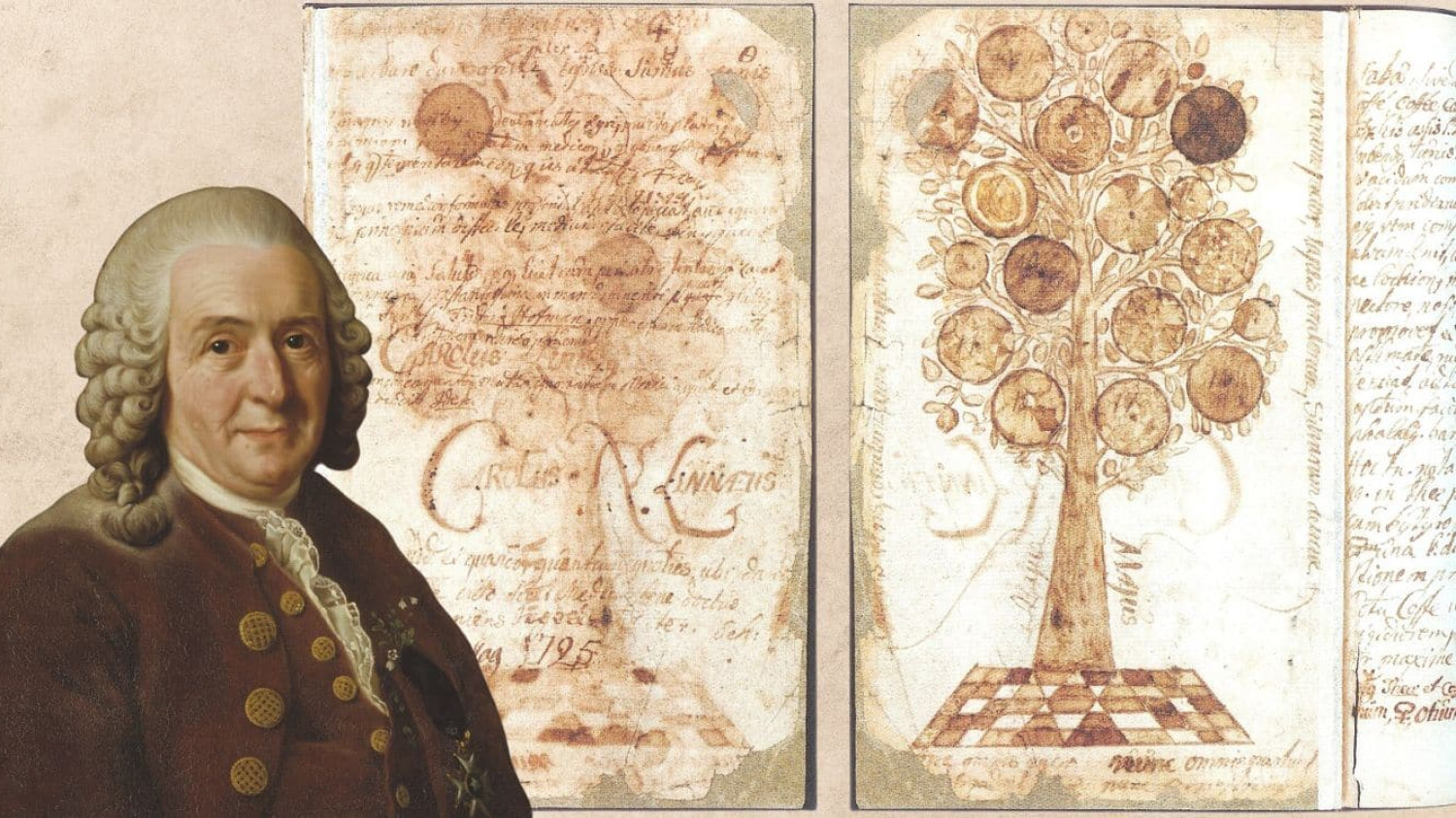
Carl Linnaeus thought it could be possible to tell the time by watching flowers. He observed that different species opened and closed at particular hours and proposed arranging them as a “floral clock”, although he probably never planted one himself. [1]
On 23 May 1707, Carl Linnaeus, botanist, physician, traveller and prolific author, was born in Sweden. Through his many books, dissertations, travel accounts and thousands of letters, he set himself the enormous task of describing and organising the natural world. Today he is best remembered as the man who gave plants and animals the two-part scientific names we still use.
The son of a clergyman who loved gardening, Linnaeus trained as a doctor at a time when medicine and botany were closely entwined. In 1741, he became Professor of Medicine at Uppsala University and transformed its neglected botanical garden into a living classroom. Here his students learned to identify plants and understand their uses. Even the poisonous specimens had their place, for a dangerous plant might also possess valuable medicinal properties when administered in the correct dose.
Linnaeus was an astonishingly industrious writer. His Systema Naturae, first published in 1735, attempted to classify animals, plants and minerals. Its first edition was a slim work of only eleven large pages, but Linnaeus revised it repeatedly until it grew into several substantial volumes. His equally important Species Plantarum, published in 1753, described thousands of plants and helped establish the system of botanical naming still followed today.
He also wrote lively accounts of his travels through Sweden, recording local customs, food, farming, medicine and the people he met, as well as the natural world around him. Meanwhile, his students—the adventurous “Linnaean Apostles”—travelled abroad collecting specimens. One of them, Daniel Solander, later sailed with Joseph Banks on Captain Cook’s Endeavour and collected plants at Botany Bay.
Linnaeus died in 1778, but his language surrounds us still. Every time we encounter a name such as Homo sapiens or Felis catus, we are using the system he made famous, part of one man’s extraordinary attempt to make the whole natural world readable.
Selected links for relevant websites, books, movies, videos, and more. Some of these links lead to protected content on this website, learn more about that here.