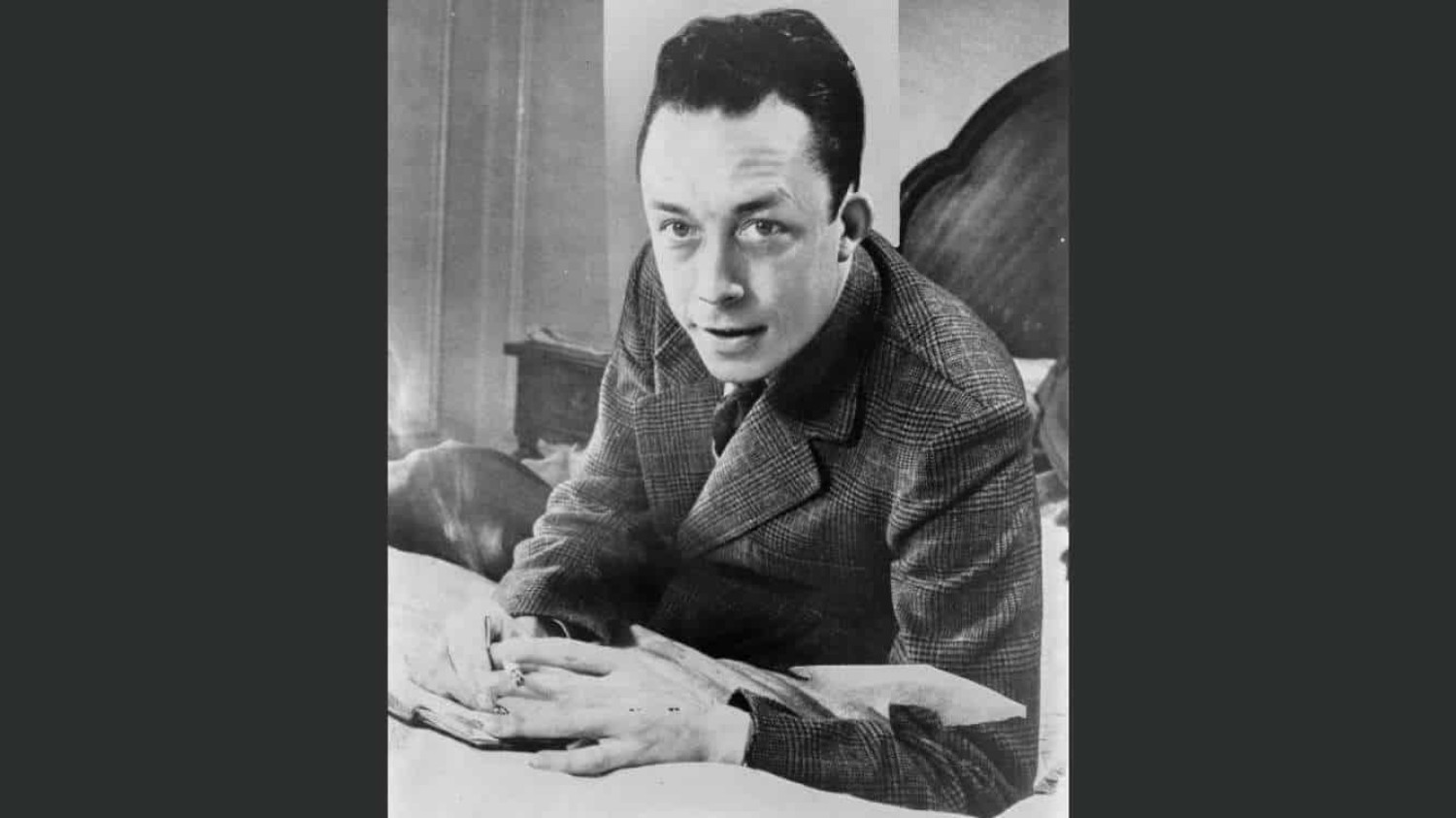
In 1941, publisher André Malraux admired the manuscript of The Stranger, arguably Albert Camus’ most famous novel, but was unable to print it. His problem was that in German-occupied France, a severe paper shortage meant there wasn’t enough paper to print it. [1]
Albert Camus was born on 7 November 1913 in Mondovi, French Algeria (now Dréan, Algeria). His father, Lucien Camus, worked as an agricultural labourer and was killed in the Battle of the Marne in 1914, shortly after his son’s birth. Young Albert was therefore raised largely by his mother, Catherine Hélène Camus, who was of Spanish origin, partially deaf, and employed as a domestic worker.
Albert attended local primary schools where his academic ability was noted by his teacher, Louis Germain. Through Germain’s encouragement, Camus gained a scholarship to attend the Lycée Bugeaud in Algiers, an opportunity that allowed him to continue his education beyond the level usually available to children of his background. He completed his secondary studies successfully and went on to enrol at the University of Algiers, where he studied philosophy and became involved in theatre and journalism, contributing to student publications and participating in amateur dramatic groups.
In 1930, at the age of 17, Camus was diagnosed with tuberculosis, which affected his health throughout his life and restricted his career paths, including his ambition to become a schoolteacher. He was only able to study part-time. To earn money, he took odd jobs, including as a private tutor, car parts clerk, and assistant at the Meteorological Institute. Despite interruptions, he completed a Licentiate degree in ancient philosophy.
In the 1940s, Camus gained international recognition with the publication of The Stranger and The Myth of Sisyphus, works that established him as a leading figure associated with absurdist thought and existentialism even though he firmly rejected the term throughout his lifetime.
In 1957, when he was 44, Camus received the Nobel Prize in Literature. He was the second-youngest recipient of the prize, after Rudyard Kipling, who was 41.
Camus married twice but had many extramarital affairs. He died on 4 January 1960 at the age of 46, in a car accident.
Selected links for relevant websites, books, movies, videos, and more. Some of these links lead to protected content on this website, learn more about that here.