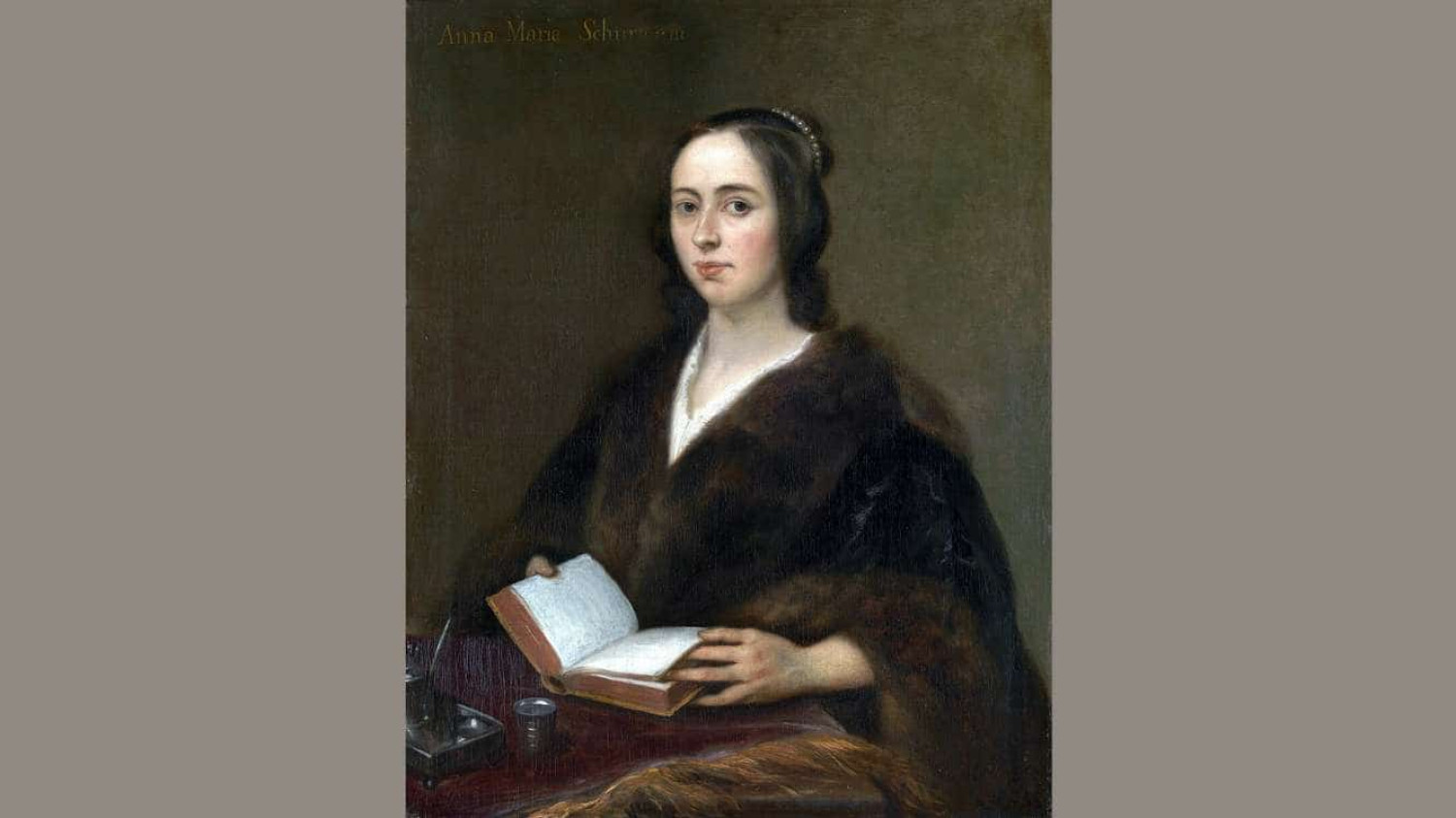
At four years old, Anna Maria van Schurman could read. When she was six, she had mastered creating highly intricate paper cut-outs that surpassed every other child her age. At the age of ten, she learned embroidery in three hours. [1]
Anna Maria van Schurman was a Dutch painter, engraver, poet, classical scholar, philosopher, and feminist writer, best known for her exceptional learning and defence of female education. She was born on 5 November 1607 in Cologne, into a family of Protestant refugees who had fled religious persecution in the Spanish Netherlands.
Her father, Frederik van Schurman, was a learned man who recognised his daughter’s extraordinary gifts early. Under his careful guidance, Anna Maria received an education usually reserved for boys and soon surpassed most of them. She became proficient in fourteen languages, a linguistic brilliance that later became central to her writing, enabling her to engage directly with biblical, classical, and contemporary texts.
After her father’s death, Anna Maria settled with her family in Utrecht, where her reputation for learning quietly spread. When the University of Utrecht was founded in 1636, she was permitted—behind a screen—to attend lectures, a symbolic acknowledgement of her intellect even as it underscored the era’s constraints on women. These experiences fed directly into her influential 1641 work, in which she argued, with calm logic and elegant Latin prose, that women were fully capable of scholarly achievement.
Writing was only one facet of her early life. She was also an accomplished poet, calligrapher, and artist, producing finely wrought verses and visual works that reflected both precision and piety.
Anna Maria van Schurman died on 4 May 1678, leaving behind a body of work that earned her reputation as one of the most learned women of the 17th century.
Selected links for relevant websites, books, movies, videos, and more. Some of these links lead to protected content on this website, learn more about that here.