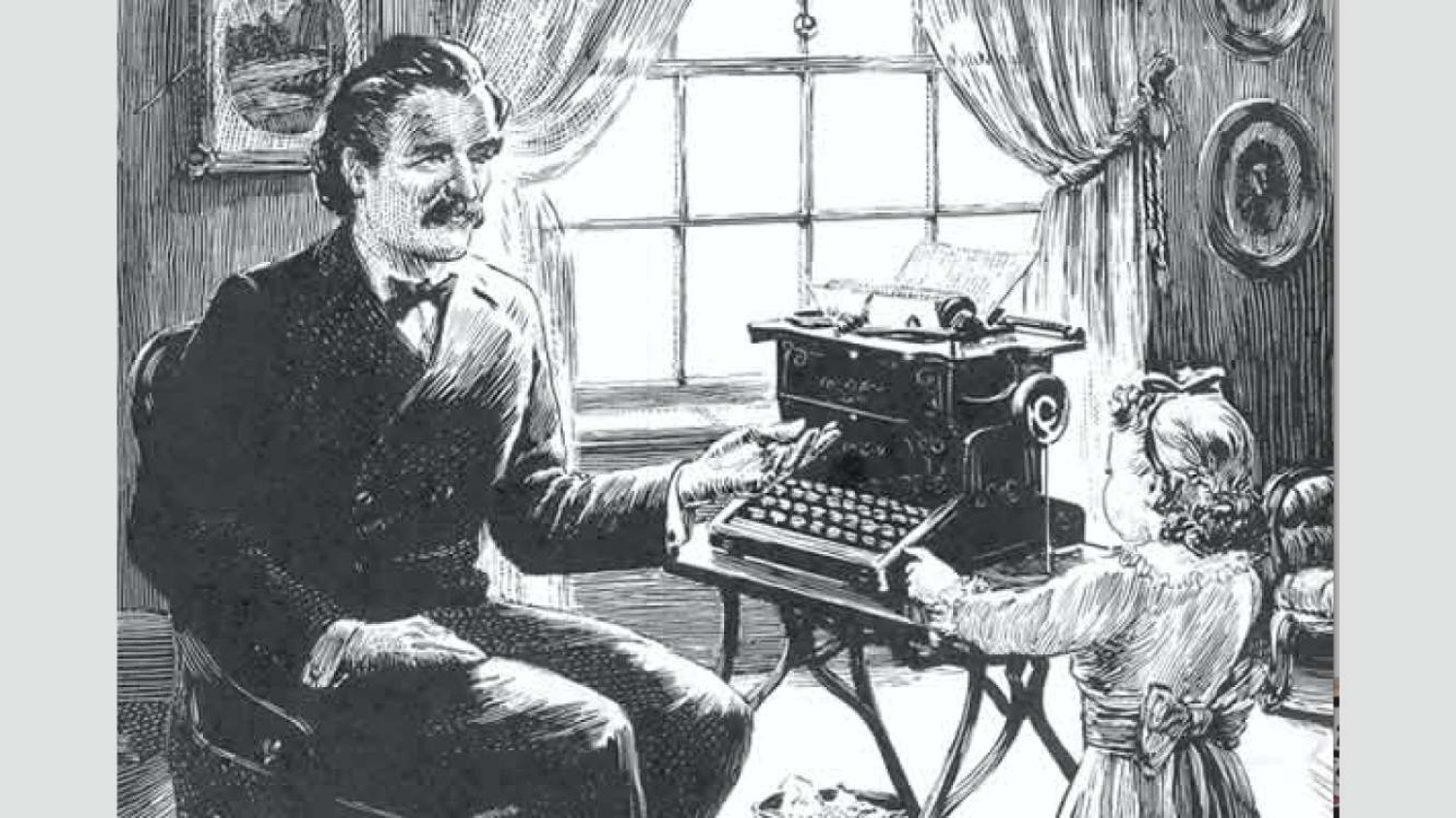
Did you know that the first author in the world to send his publisher a manuscript typed on a typewriter was Mark Twain? The book was Life on the Mississippi, although Twain may have asked an assistant to type it rather than hitting the keys himself.
Twain loved new technology. He bought a typewriter in 1871 and began typing his correspondence in 1874 on his “new fangled writing machine”.
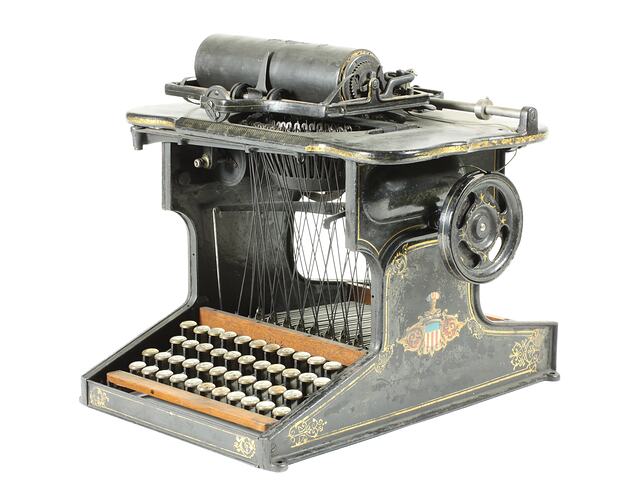
The new invention sometimes drove him mad, reducing him to swearing and even sending letters complaining about the machine to E. Remington & Sons.
He stated that every time he sent a typed letter to an acquaintance, he would get a letter back asking him to describe the machine and explain what progress he had made in using it. He even claimed that the new machine was “ruining his morals”. In his autobiography he writes that he dictated his 1876 novel, The Adventures of Tom Sawyer to his ‘machinist’, but his memory might have been muddled as the book was printed from his hand-written manuscript and not from a typed one. In his early years Twain had served an apprenticeship with a printer and had worked as a typesetter. He called the typewriter “a curiosity-breeding little joker”.
So just how new was this useful machine? The first practical and commercially successful typewriter was patented in 1868 by an American inventor Christopher Scholes, along with Carlos Glidden and Samuel W. Soule. It featured the QWERTY keyboard layout and was manufactured by E. Remington & Sons in 1873. The QWERTY layout was designed to avoid jamming in the early models of the machine. The early models were designed for offices, rather than home use, and were often mounted on stands, rather like old-fashioned sewing machines. Typists could not see their own work, until the paper was rolled upwards. The new invention caught on quickly, in America and Britain, and by the 1890s typewriters were seen as essential office tools.
However, the idea of such an object dates back to 1714, when an Englishman named Henry Mill filed a very vaguely-worded patent for such a machine. The first typewriter proven to have actually worked was Italian, created in 1808 to help a blind person. In the 19th century, different inventors worked on the idea (Nietzsche was given a very early model which had a writing ball and looked rather like a pincushion, but he detested it), and early models were very expensive.
Typewriters created a whole new industry and workforce. Women began to train as typists. Factories had to make them, the paper and ribbon cartridges had to be supplied, and soon writers turned to this way of creating their works. Agatha Christie commented: “There is no doubt that the effort involved in typing … does help me in keeping to the point.” Her Remington typewriter can still be seen at her home Greenway today.
Have you ever used a manual typewriter? Let me know by leaving a comment.
Selected links for relevant websites, books, movies, videos, and more. Some of these links lead to protected content on this website, learn more about that here.
Yvonne
Yes I have. More than 60 years ago our whole class at high school learnt to type. We had a piece of paper over our hands do we could not look at the keys when typing! We took dictation etc, learnt how to use that blue paper in between , but for the life of me , I can’t remember what we did with that afterwards.
My dad brought a typewriter home from the office so I could practice. The keys were round with a slightly raised rim.
I enjoyed typing but never really used this skill in my working life.
Susannah Fullerton
Typewriters seem so old-fashioned now, don’t they, and yet they were once so useful in so many places. I also did a typing class at school. Now very small children are learning to type on computers.
Sally Petherbridge
I learned to type on a manual typewriter in 1974. In my course, we were also introduced to electric typewriters – state of the art at that time! It’s quite a skill, as there are some fancy things you can do, and you learnt not to make mistakes as they were difficult to correct. I’m sure my typing was much better in those days than it is now, with the benefit of spellcheck. When I’m feeling fed up with modern technology, I comfort myself with the thought that the current generation has no idea how to use a manual typewriter! It has proved to be a really useful skill and I feel pained when I happen to see anyone typing with two fingers.
Susannah Fullerton
Yes, watching someone typing with only two fingers is difficult! Typewriters were amazing inventions and must have been a big bonus to writers who were sick of having to write by hand.