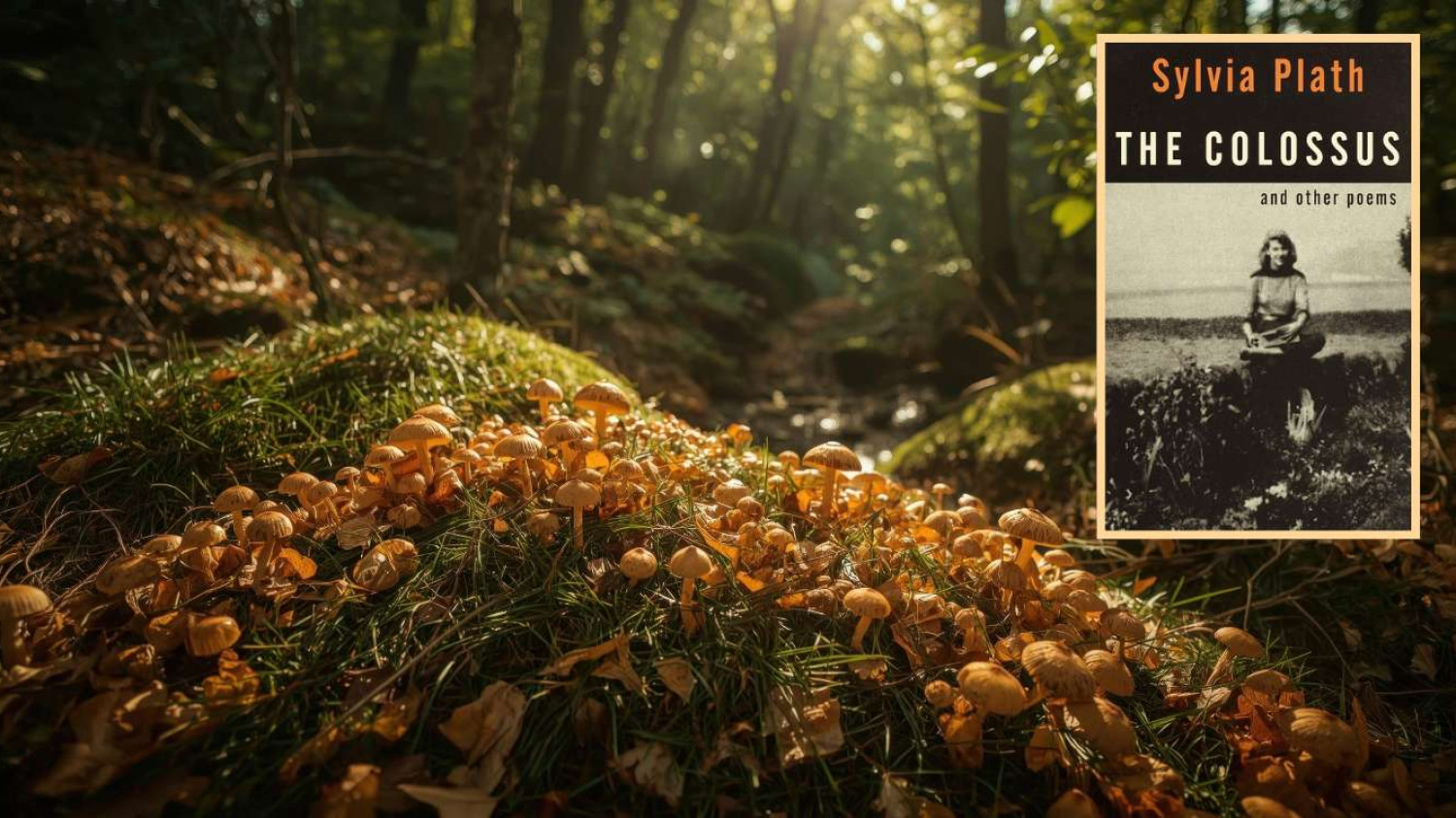
I have never included a Sylvia Plath poem in my Poem of the Month selection, so here’s one from that fascinating American poet.
Mushrooms by Sylvia Plath
Overnight, very
Whitely, discreetly,
Very quietly
Our toes, our noses
Take hold on the loam,
Acquire the air.
Nobody sees us,
Stops us, betrays us;
The small grains make room.
Soft fists insist on
Heaving the needles,
The leafy bedding,
Even the paving.
Our hammers, our rams,
Earless and eyeless,
Perfectly voiceless,
Widen the crannies,
Shoulder through holes. We
Diet on water,
On crumbs of shadow,
Bland-mannered, asking
Little or nothing.
So many of us!
So many of us!
We are shelves, we are
Tables, we are meek,
We are edible,
Nudgers and shovers
In spite of ourselves.
Our kind multiplies:
We shall by morning
Inherit the earth.
Our foot’s in the door.
The poem was written in 1959 and published in 1960 in her first collection, The Colossus and Other Poems. It’s a poem about endurance, resilience and perseverance. It explores the idea that the oppressed will eventually rise up and find their place.
It is narrated as if by the mushrooms themselves, finding their way up through the earth to the surface, taking what they need from the water and the air. They make a silent invasion into the world. They are meek and bland-mannered, appearing passive, and yet they exert a quiet and relentless agency, insisting on finding their place. For many readers, the mushrooms represent women, as Sylvia Plath loved in her writings to explore the patriarchy and female constraints (the very short stanzas add to the sense of compression). She was writing the poem at the time of the Cold War, and the language of silent infiltration and subversion was appropriate to that era. It’s a metaphorical poem, using the mushroom as a symbol for the oppressed.
In 1959, she and her husband, Ted Hughes, were at Yaddo, the artists’ colony at Saratoga Springs, New York. She was pregnant, but was struggling to find publishers for her work. She was depressed and finding it terribly hard to write, in spite of having a room of her own (Ted stayed in his own room in another part of the colony). To relieve the frustration of not being able to put words down on the page, she went for long walks in the Yaddo woods, which were full of mushrooms (they were often served at meals there). The walks revived her, she suddenly heard from a publisher accepting one of her stories, and she began to feel more optimistic. Life, she felt, like the fungi, could not be kept down forever. She wrote an essay on mushrooms, which Ted praised, and that poem became this poem which pays homage to the indomitable nature of the creative spirit. Today, mushrooms are used in the treatment of depression, although Plath never lived to know that.
You can listen to the poem read by Sylvia Plath herself:
The poem has been set to music at various times and remains one of Plath’s most popular poems.
Have you enjoyed this poem? I’d love to know what you think, let me know by leaving a comment.
Selected links for relevant websites, books, movies, videos, and more. Some of these links lead to protected content on this website, learn more about that here.
Suzanne Williams
Some time since I’ve read a poem I really appreciated. Thank you for including it.
I think the beach scene is on the east coast not far from Vanessa Bell’s home which we visited in 2023.
Susannah Fullerton
So glad you liked the poem. She was an intriguing poet.
Graham H.
Sylvia Plath, one of the greats, yes, thanks for including. But what’s with the gratuitous husband endorsement? “She wrote an essay on mushrooms, which Ted praised”?? Reminds me of that great quote from “The Man in the Brown Suit” by Agatha Christie:
“I objected vigorously to this unsporting proposal. I recognized in it the disastrous effects of matrimony. How often have I not heard a perfectly intelligent female say, in the tone of one clinching an argument, “Edgar says—” And all the time you are perfectly aware that Edgar is a perfect fool. Suzanne, by reason of her married state, was yearning to lean upon some man or other.”
Susannah Fullerton
I don’t think it is a gratuitous endorsement when it was his praise that did actually encourage her to turn her essay into a poem.