The judge in the Lady Chatterley’s Lover trial had some help with his reading: his wife, Dorothy, marked significant passages in his copy and even sewed a cloth bag for him to carry the book to and from court. [1]
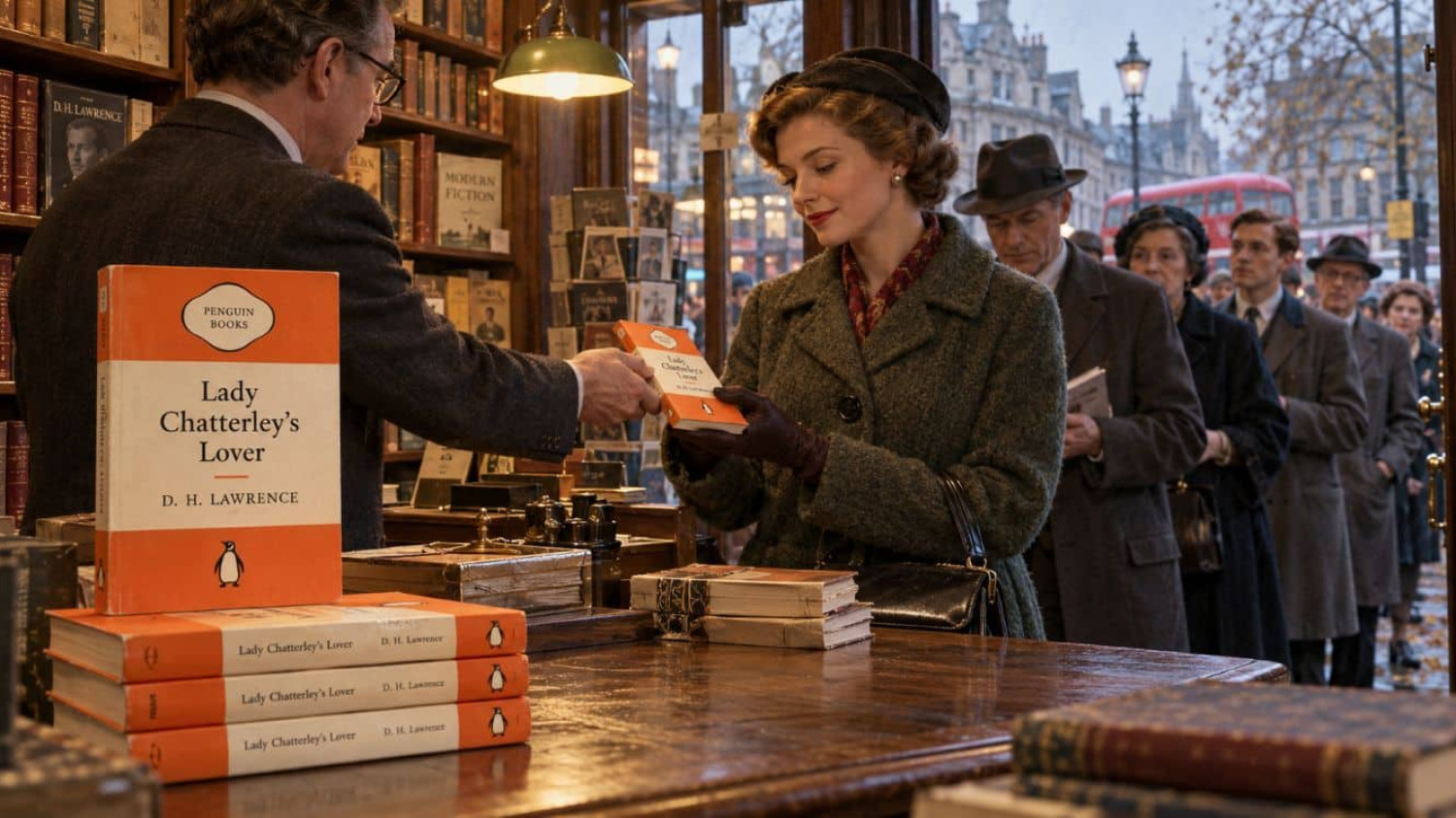
On 10 November 1960, British readers bought 200,000 copies of D.H. Lawrence’s Lady Chatterley’s Lover, exhausting Penguin’s first printing on its first day of general sale. For a novel first published privately in Florence in 1928, it was an extraordinary arrival in bookshops. Although a censored British edition had appeared in 1932, readers could at last buy the complete text openly, following one of the most famous trials in literary history.
Lawrence tells the story of Constance Chatterley, whose husband Clifford has been paralysed by a war injury. Lonely and increasingly unhappy in her marriage, she begins an affair with his gamekeeper, Oliver Mellors. Their relationship crosses the boundaries of class as well as marriage. Its explicit language and descriptions of sex caused outrage, but Lawrence was also exploring tenderness, emotional isolation and the need for human connection.
Penguin’s decision to issue the novel as an affordable paperback brought these questions into the courtroom. Prosecuted under the Obscene Publications Act of 1959, the publisher could defend the book on grounds of literary merit and public benefit. E.M. Forster and other distinguished witnesses supported it. Prosecutor Mervyn Griffith-Jones famously asked whether it was a book “you would even wish your wife or your servants to read”. His question revealed rather more about social attitudes than he perhaps intended.
On 2 November, the jury returned a verdict of not guilty. Eight days later, the general release brought the waiting copies to an eager public. The publicity had certainly encouraged curiosity, but the verdict’s importance went beyond the fortunes of one novel. It helped widen the freedom of British publishers and readers.
Lawrence had died thirty years earlier and never saw this vindication. Penguin’s 1961 edition carried an unusual dedication: to the twelve jurors who had made his last novel freely available. Few authors can have owed quite so much to a jury.
Selected links for relevant websites, books, movies, videos, and more. Some of these links lead to protected content on this website, learn more about that here.
Lady Chatterley’s Lover by D.H. Lawrence
Gutenberg: Lady Chatterley’s Lover
Penguin Books: The book that changed Britain
The Globe & Mail: The day the courts freed Lady Chatterley’s Lover
Lawrence’s Eastwood: D.H. Lawrence
Susannah Fullerton: D.H. Lawrence & Piano
Susannah Fullerton: D.H. Lawrence & Afternoon in School – The Last Lesson
Susannah Fullerton: Brief Encounters: Literary Travellers in Australia 1836-1939