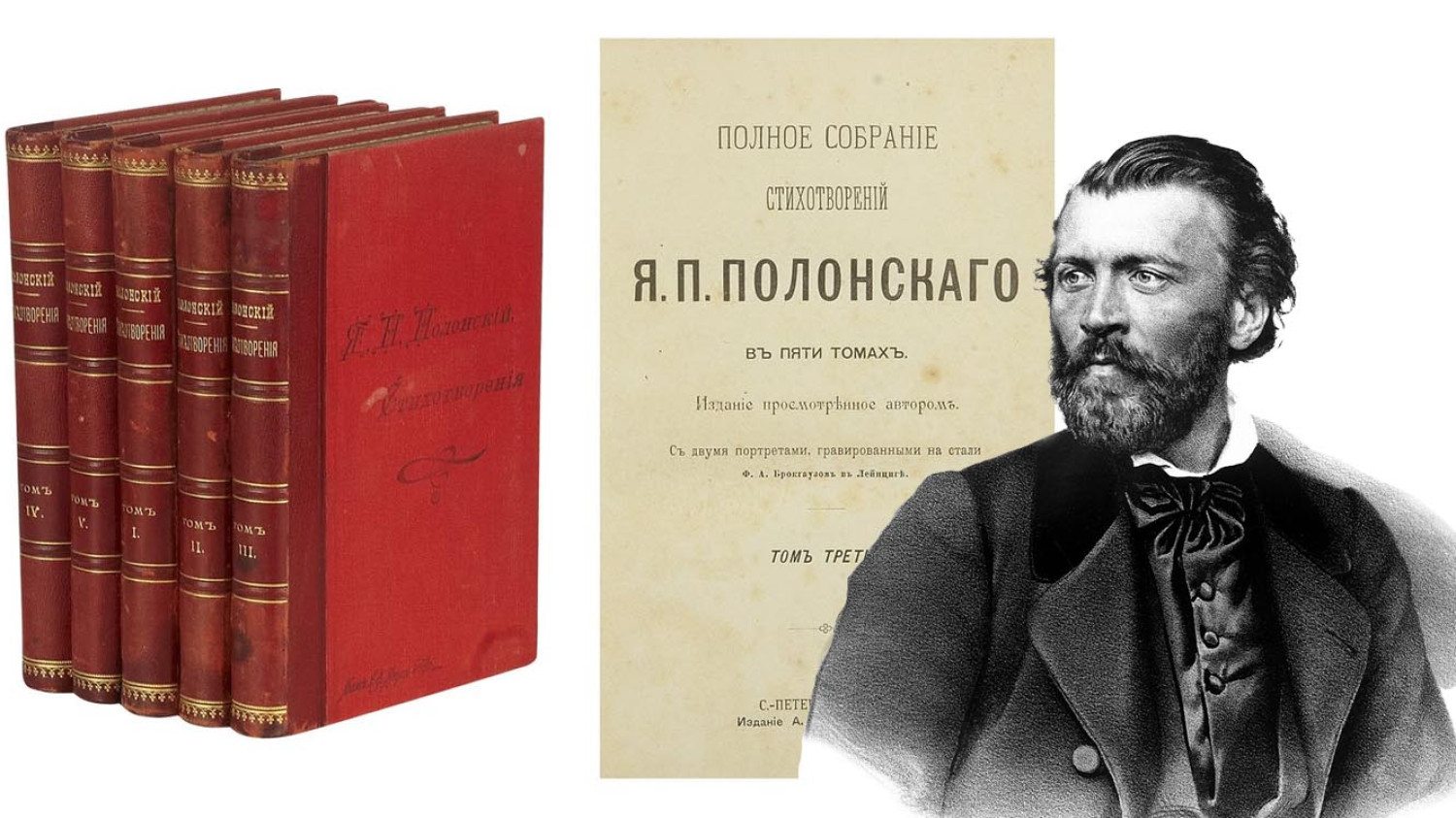
Yakov Polonsky provided the libretto for Tchaikovsky’s opera Vakula the Smith (1874, revised in 1885 as Cherevichki), based on Nikolay Gogol’s story Christmas Eve. [1]
Yakov Petrovich Polonsky was a significant Russian lyric poet, preserving the traditions of Romanticism even as the era was becoming dominated by realist prose. He was born on 18 December 1819 in Ryazan, a provincial city of ancient cathedrals east of Moscow.
His father, Pyotr Alekseyevich, held a modest administrative position, while his mother, Anna Kirillovna, belonged to a respected merchant family. Although the household’s finances were frequently strained, the family maintained a strong commitment to education, faith, and cultural tradition. Young Yakov grew up surrounded by the rhythms of Russian storytelling and the Orthodox liturgy, which later found their way into the musicality of his verse.
Polonsky’s early education took place at the Ryazan Gymnasium, where he displayed an aptitude for languages and literature. Teachers noted his quiet diligence rather than brilliance, yet he revealed an imagination alert to atmosphere, colour, and the emotional undercurrents of everyday life. In 1838, he entered Moscow University to study law, though it soon became evident that legal matters held far less charm for him than the city’s intellectual culture. The student life was difficult for Polonsky – he was poor and had to earn extra money by giving private lessons. He attended literary evenings, read voraciously, and soon found his own voice as a poet was beginning to steady and strengthen. His first poems appeared during his student years.
Graduating from Moscow University in 1844, Polonsky published his first collection of poems that same year. In 1851, he appeared in Saint Petersburg, and in 1855, he published the Poems book, which was well received by critics, and became a regular contributor to Saint Petersburg magazines.
In 1858, in Paris, Yakov Polonsky met Elena Vasilievna Ustyuzhskaya, the 18-year-old daughter of a parish clerk of the Russian Orthodox Church. Soon she became his wife. However, their happiness did not last for long. In January 1860, his 6-month-old son Andrei died. His beloved wife fell ill and died six months later. In 1866, he met Josephina Antonovna Ryulman, who became his second wife and had a family of three children.
Although Polonsky was highly regarded in his own day, he is best remembered now as a refined voice of the Russian Romantic and post-Romantic tradition—a lyric poet whose work has endured for its elegance.
Selected links for relevant websites, books, movies, videos, and more. Some of these links lead to protected content on this website, learn more about that here.