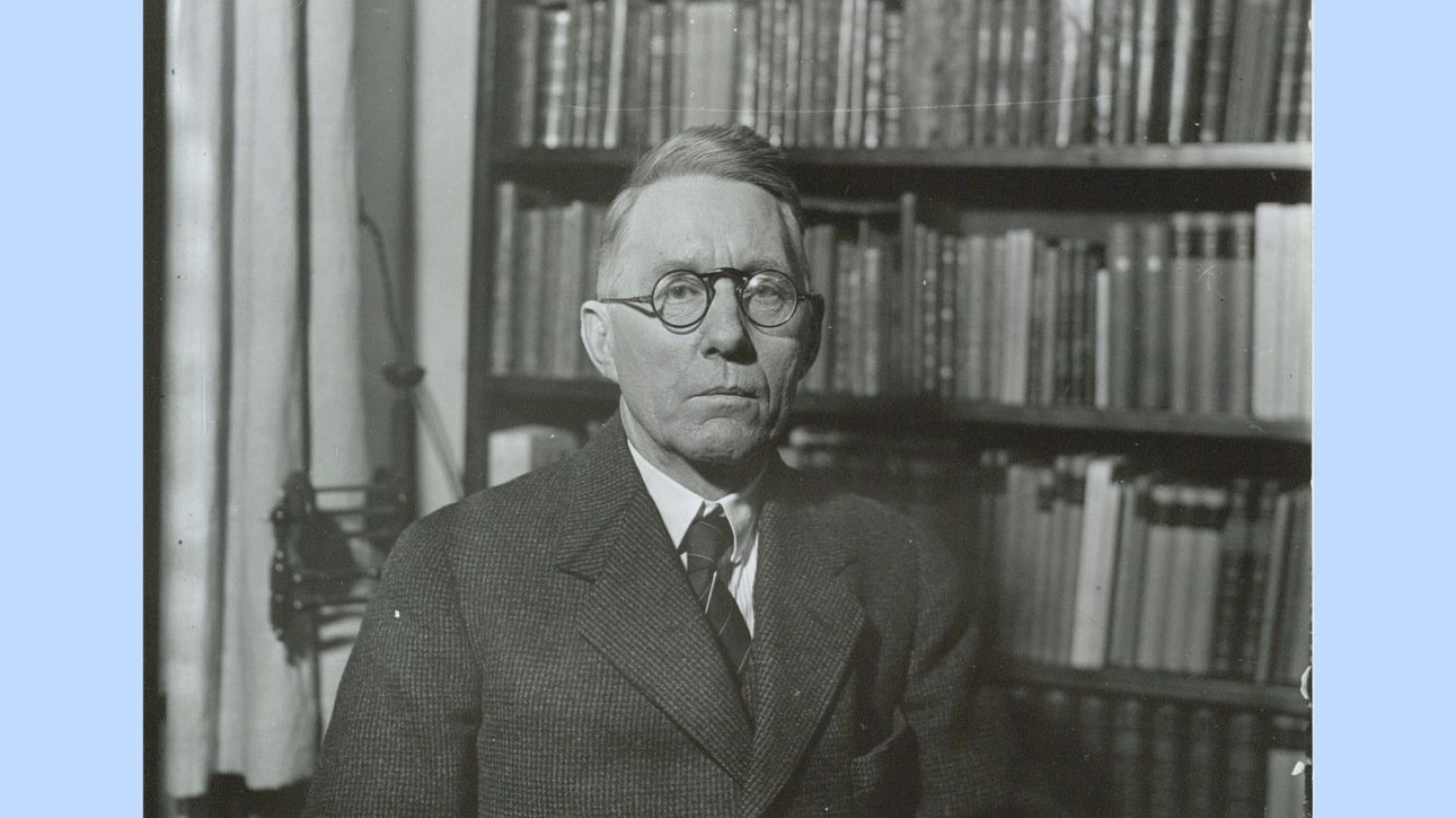
Just a week before his death, Johannes V. Jensen corrected the proofs of an obituary for his friend Hartvig Frisch. [1]
On 25 November 1950, Danish writer Johannes V. Jensen died in Copenhagen, aged 77. He was a novelist, poet and essayist, and his writing ranged widely – from the people and landscapes of his native Jutland to an imagined history of humankind.
Jensen first won readers with Himmerlandshistorier (Himmerland Stories), drawing on the rural district where he grew up. His characters are vivid, and the stories are full of humour. He later wrote Kongens Fald (The Fall of the King), a historical novel published in three parts between 1900 and 1901. Set in the time of King Christian II, it follows the king and Mikkel Thøgersen, a student from Jutland caught up in the upheavals of the age. The novel’s blend of history, drama and lyrical writing helped make it one of Denmark’s most acclaimed works of fiction.
Jensen wrote much more than novels. The open, energetic form of the prose poems in Digte (Poems, 1906) helped begin a new direction for Danish poetry. He also wrote short pieces he called Myter (Myths), nine collections of them between 1907 and 1944. And in Den lange Rejse (The Long Journey), six novels carry readers from prehistory to the discovery of America.
Jensen received the Nobel Prize in Literature in 1944, recognised for his vivid imagination, wide-ranging curiosity and fresh, bold style. He was a writer with an unusually broad view of the world, yet many of his stories begin close to home, among the people and places he knew so well.
Selected links for relevant websites, books, movies, videos, and more. Some of these links lead to protected content on this website, learn more about that here.