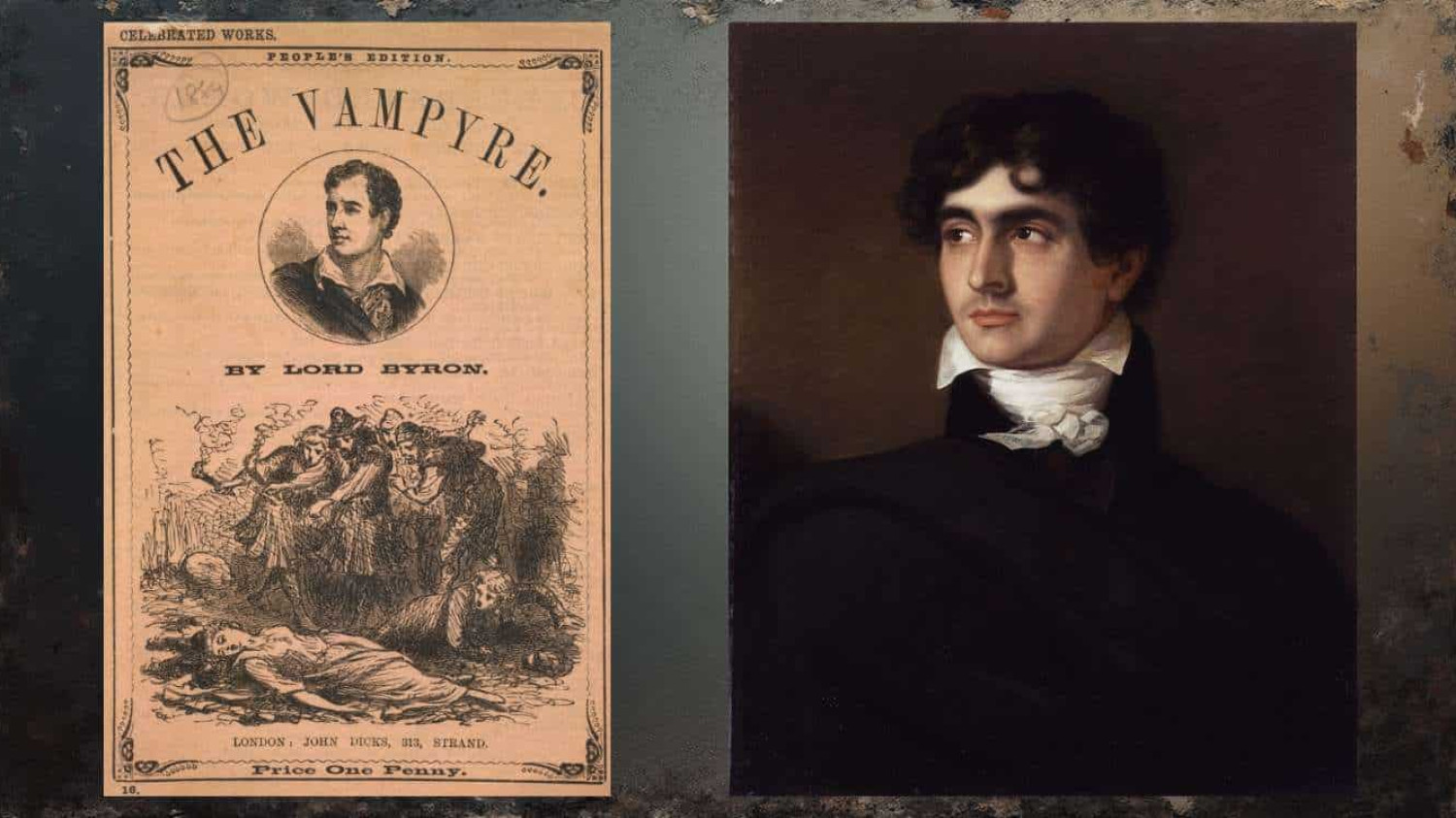
Fragment of a Novel is an unfinished gothic horror story begun by Lord Byron at the Villa Diodati during the famous ghost-story challenge in June 1816. It first appeared under the title “A Fragment” in the 1819 collection Mazeppa: A Poem, published by John Murray in London. [1]
On 1 April 1819, readers of London’s New Monthly Magazine encountered a curious new tale, boldly titled “The Vampyre: a tale by Lord Byron.” It was an arresting announcement: Byron, already the scandalous darling of Romanticism, had apparently ventured into Gothic fiction. Almost at once the work appeared in book form, again bearing Byron’s illustrious name. Yet the story was not his. Its true author, John William Polidori, had been Byron’s young and unfortunate physician, a man whose brief life and complicated association with the poet would cast a long shadow over literary history.
Polidori had joined Byron’s entourage in 1816, the year of the poet’s self-imposed exile after his disastrous marriage and ensuing public vilification. That summer, at the Villa Diodati on Lake Geneva, Byron and his circle—among them Percy Shelley and Mary Shelley—challenged one another to write a ghost story. The results were extraordinary. Mary Shelley created a work of enduring genius: Frankenstein, published in 1818, and Polidori shaped his contribution into something quite new—a chilling narrative about an enigmatic nobleman with a deadly secret.
The Vampyre introduced Lord Ruthven, a cold, aristocratic, irresistibly alluring figure whose predatory nature is slowly revealed. In crafting Ruthven, Polidori drew upon Byron’s infamous charisma, giving the tale a frisson that helped fuel the public’s mistaken assumption of Byron’s authorship. The publisher Henry Colburn, eager for sales, did nothing to dispel the misunderstanding; indeed, the first state of the book edition (now lost) credited Byron outright. Both men protested the error, but its commercial impact was undeniable. The story became an immediate success.
Polidori (1795–1821), the London-born son of an Italian scholar and an English governess, had earned his medical degree at just twenty. Yet The Vampyre would far outlive his short and troubled life. He died in 1821, probably by his own hand, unaware of the genre he had inaugurated.
For from this slight Gothic tale sprang an extraordinary literary lineage. The Vampyre is the first vampire story in the English language, the ancestor of Bram Stoker’s Dracula and, much later, the many modern reinventions that populate our bookshelves and screens. With its brooding aristocrat and blood-stained glamour, Polidori’s tale changed the mythology of the undead forever.
Gutenberg: The Vampyre; A Tale by John William Polidori
Wikisource: Mazeppa, a Poem/A Fragment by Lord Byron
The London Magazine
The Haunted Writing Life of John Polidori
Susannah Fullerton: Lord Byron proposes a literary challenge
Susannah Fullerton: About Mary Shelley
Susannah Fullerton: Percy Bysshe Shelley
Susannah Fullerton: ‘Frankenstein’ is 200
Susannah Fullerton: Dracula is published