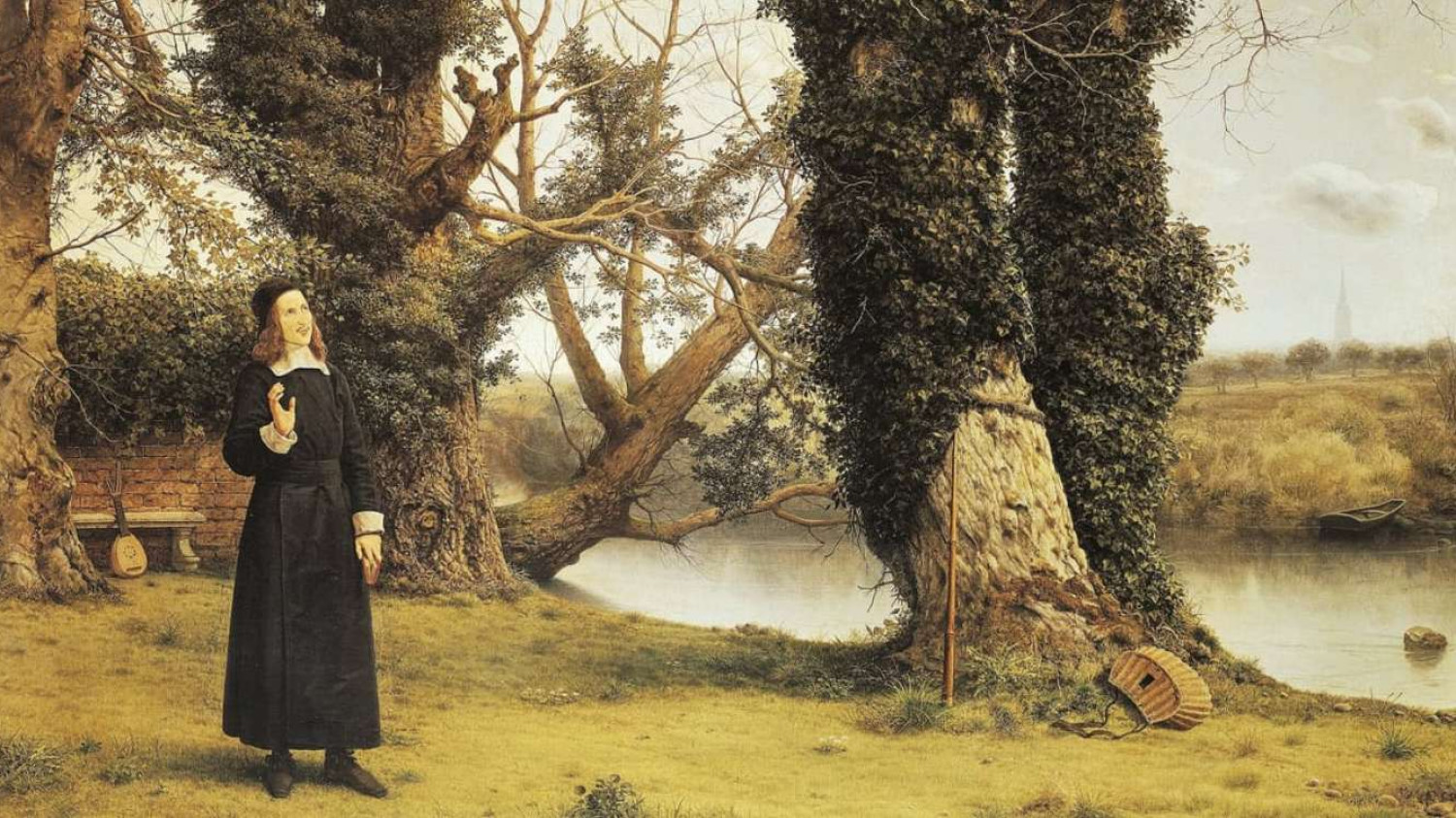
As a student at university, I had to study the poems of 17th-century clergyman George Herbert. I am not religious, but I did fall in love with his poetry – it is simple, sincere and very beautiful. Coleridge said of Herbert’s use of language, “nothing can be more pure, manly, or unaffected”. Herbert is considered one of the greatest of the Metaphysical Poets (poets whose work was characterised by verbal conceits, word-plays, unusual metaphors, speculations – John Donne is the most famous of the group). He also created some amazing ‘shaped’ poems, for example, The Altar written in the shape of an altar, and Easter Wings in the shape of two sets of wings.
This is one of my favourite Herbert poems, dated 1633.
Love (III) by George Herbert
Love bade me welcome. Yet my soul drew back
Guilty of dust and sin.
But quick-eyed Love, observing me grow slack
From my first entrance in,
Drew nearer to me, sweetly questioning,
If I lacked any thing.
A guest, I answered, worthy to be here:
Love said, You shall be he.
I the unkind, ungrateful? Ah my dear,
I cannot look on thee.
Love took my hand, and smiling did reply,
Who made the eyes but I?
Truth Lord, but I have marred them: let my shame
Go where it doth deserve.
And know you not, says Love, who bore the blame?
My dear, then I will serve.
You must sit down, says Love, and taste my meat:
So I did sit and eat.
The poem is a wonderfully intimate one. It is in the form of a simple dialogue between a host and a guest, but also between God and a human soul. God is personified as the figure ‘Love’, a host welcoming into his house an unwilling guest. The guest, or ordinary human sinner, feels unclean and reluctant, but Love persuades him that as he created him, sins and all, there is no need to hide anything or feel ashamed. He must come in and eat. The ‘house’ into which the speaker is invited can also be seen as the church, or as the divine afterlife.
As is typical of Herbert, the poem contains verbal complexities – the pun on ‘eyes’ and ‘I’ and the varied uses of look / quick-eyed / observing etc, the word ‘serve’ which has both religious and dinner related meanings, the association of ‘taste my meat’ with Communion (the eating of consecrated bread so as to enter into an especially close relationship with Christ). The simple rhyme scheme never deviates, which gives the reader a sense of safety, of being soothed by the words, just as the guest is soothed. The language is straightforward and unintimidating – the sort of language used between friends in everyday situations.
This poem is both simple and brilliantly complex. It is a love poem, as its title shows, which works on three levels. On a literal level, it is a simple tale of a human lover or a friend inviting the poet inside for an intimate meal for two. On an allegorical level, the host is ‘Love’ personified, asking the poet to let love into his life. The religious level shows God as ‘Love’, courting and reassuring a lost soul, inviting him to take Communion and come back into the fold.
You can listen to Ralph Fiennes reading the poem here
Do seek out some more of Herbert’s poems – The Collar, The Pulley, The Windows. Or read about his life in the recent biography Music at Midnight: The Life and Poetry of George Herbert by John Drury. I read it last year and can thoroughly recommend it.
Did you enjoy this poem? Let me know by leaving a comment.
Selected links for relevant websites, books, movies, videos, and more. Some of these links may lead to protected content on this website, learn more about that here.