
We all know of Joseph Stalin as a monstrous Soviet dictator, responsible for the deaths of millions of people. But did you know he was a voracious reader, with over 25,000 books in his library? Stalin’s Library: A Dictator & His Books by Geoffrey Roberts explores the books Stalin read and what they taught him, looks at what he wrote, and his editing of the works of others. Stalin’s reading tastes seem to have been broad – from Victor Hugo and Zola to the great Russian writers Tolstoy and Dostoevsky, Dickens and Shakespeare, through to film scripts and political speeches. He was all his life a student of socialism, reading Marx and Lenin over and over again. He loved writing in margins and as many of the books of his personal library survive, it is possible to follow his thought processes as he read his way through the pages he annotated. There is no doubt that Stalin believed in the transformative power of words. He called writers “engineers of the human soul”.
I also found it fascinating to learn what happened to his library (held in several of his homes) after Stalin’s death and his eventual fall from political favour. I never knew that the Bolshevik government created a vast network of libraries and reading rooms, so that most people had such a place within a ten-minute walk of their home (even at the end of WWII, there were still about 80,000 such places left). The Bolsheviks wished the public to read classics which had been translated into Russian.
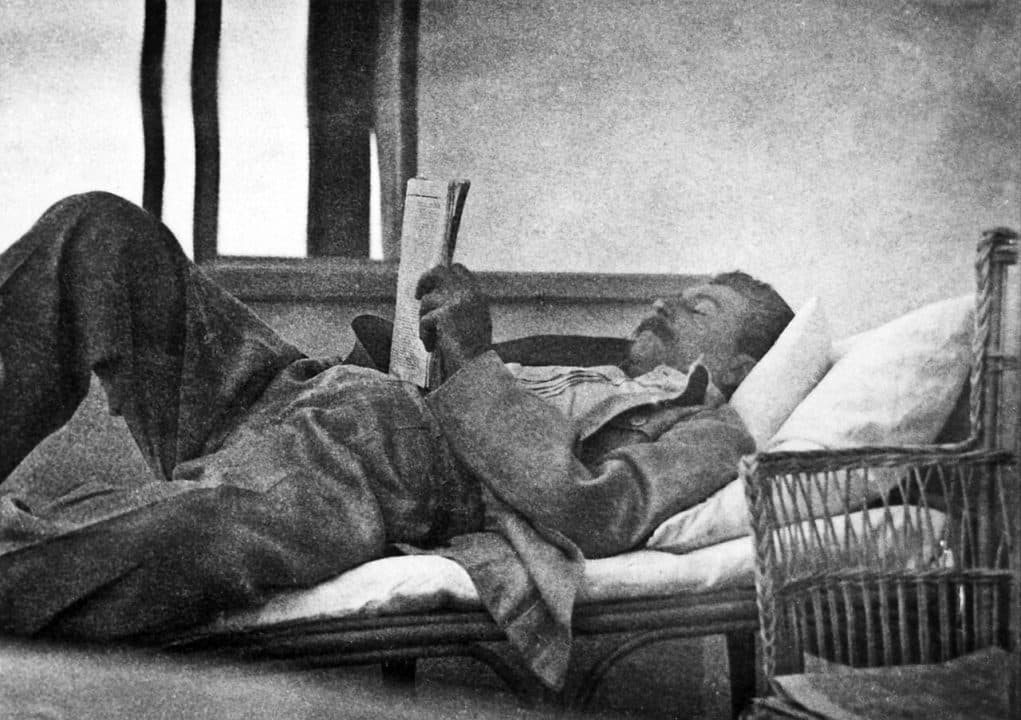
I still do not like or approve of Stalin as a man (he was responsible for the deaths of millions of people), but this book did make me see another side to him – he was incredibly hard-working, he removed adulatory references to himself from biographies, he encouraged reading and he tried to spend at least two hours a day reading himself. It was his love of reading that drew him into the revolution and gave him an intellectual assurance he would otherwise have lacked. He read many works by people he didn’t agree with, such as Trotsky, making frantic marginal notes as he went. He wrote his own versions of Soviet history, quoting other authors frequently, and he made alterations to play and film scripts and loved watching the end results. His writings were all bestsellers in the USSR, and his words were read by millions.
I do love biographies that show a person from history through his or her choice of books. This book was an intriguing read, though I did get a little confused by the many political parties in conflict before Stalin came to power. Have you read any similar biographies? Let me know in a comment.
Selected links for relevant websites, books, movies, videos, and more. Some of these links lead to protected content on this website, learn more about that here.
John Colvin
“He removed adulatory references to himself from biographies.” I haven’t read Roberts’ book, but this comment seems as unlikely as if the same were to be said of Donald Trump. Trump’s ‘library’ must be minimal compared to Stalin’s.
Susannah Fullerton
I was also astonished when I read such comments, but it does seem that for Stalin it was the Communist Party that was all important and he wanted that glorified, rather than himself personally. Trump, I fear, only wants self-glory and seems unable to utter a sentence that does not praise himself. I also fear that Trump never reads a book. The world might be a better place if he did!
janet cantor
You will forgive me, this kind of description reminds me of an announcement that Hitler loved flowers and poetry. It is usually offered as satire or worse.