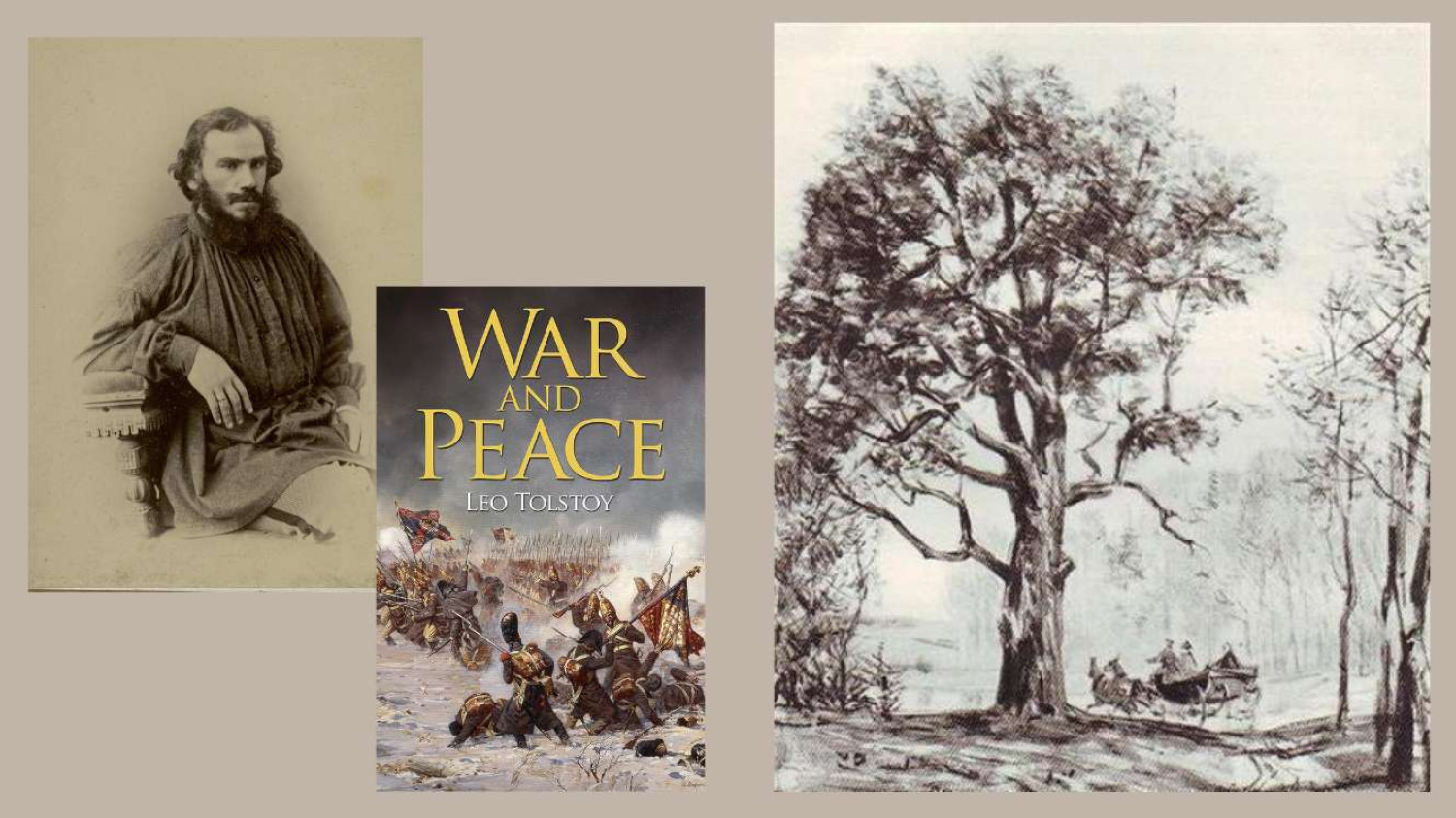
In Tolstoy’s War and Peace, Prince Andrei is travelling through the Russian countryside. He is in a state of despair. His wife has died in childbirth, he is estranged from his father, he cuts himself off from friends and, although only in his thirties, thinks his life is over. And then he pauses to look at a large oak tree: “At the side of the road stood an oak. Probably ten times older than the birches of the woods, it was ten times as thick and twice as tall as any birch. It was an enormous oak, twice the span of a man’s arms in girth, with some limbs broken off years ago, and broken bark covered with old scars. With its huge, gnarled, ungainly, unsymmetrically spread arms and fingers, it stood, old, angry, scornful, and ugly amidst the smiling birches. It alone did not want to submit to the charm of spring and did not want to see either the springtime or the sun.
“Spring, and love, and happiness” the oak seemed to say. “And how is it you are not bored with the same stupid, senseless deception! Always the same and always a deception! There is no spring, no sun, no happiness. Look, there, at those smothered, dead fir trees, always the same; look at me spreading my broken splayed fingers wherever they grow – from my back, from my sides. As they’ve grown, so I stand, and I don’t believe in your hopes and deceptions.”
The “aged monster” oak tree becomes an important symbol in the novel for Andrei’s internal state. It is the sight of the tree that persuades him that perhaps there is hope in his future after all. He travels on to the Rostov estate, and there he meets Natasha and falls in love.
The oak tree is believed to have been based on a huge oak on Leo Tolstoy’s Yasnaya Polyana estate, the home about 200km from Moscow which he inherited and deeply loved. The oak stands in the forest area of the estate, an area where cutting down trees has been forbidden since the time of Tolstoy’s grandfather, and it is thought to be about 400 years old. The tree has been officially recognised as an important literary landmark.
What do you think about this literary tree? Tell me your thoughts in a comment.
Selected links for relevant websites, books, movies, videos, and more. Some of these links lead to protected content on this website, learn more about that here.
War and Peace by Leo Tolstoy
War and Peace by Leo Tolstoy
Anna Karenina by Leo Tolstoy
Anna Karenina by Leo Tolstoy
Google Arts & Culture: Take a tour through Tolstoy’s home
Susannah Fullerton: Leo Tolstoy is born
Susannah Fullerton: Leo Tolstoy dies
Susannah Fullerton: 5 Favourite Family Sagas
Susannah Fullerton: How long should a work of fiction be?
Susannah Fullerton: Dying Words of Authors
Susannah Fullerton: Historical Novels