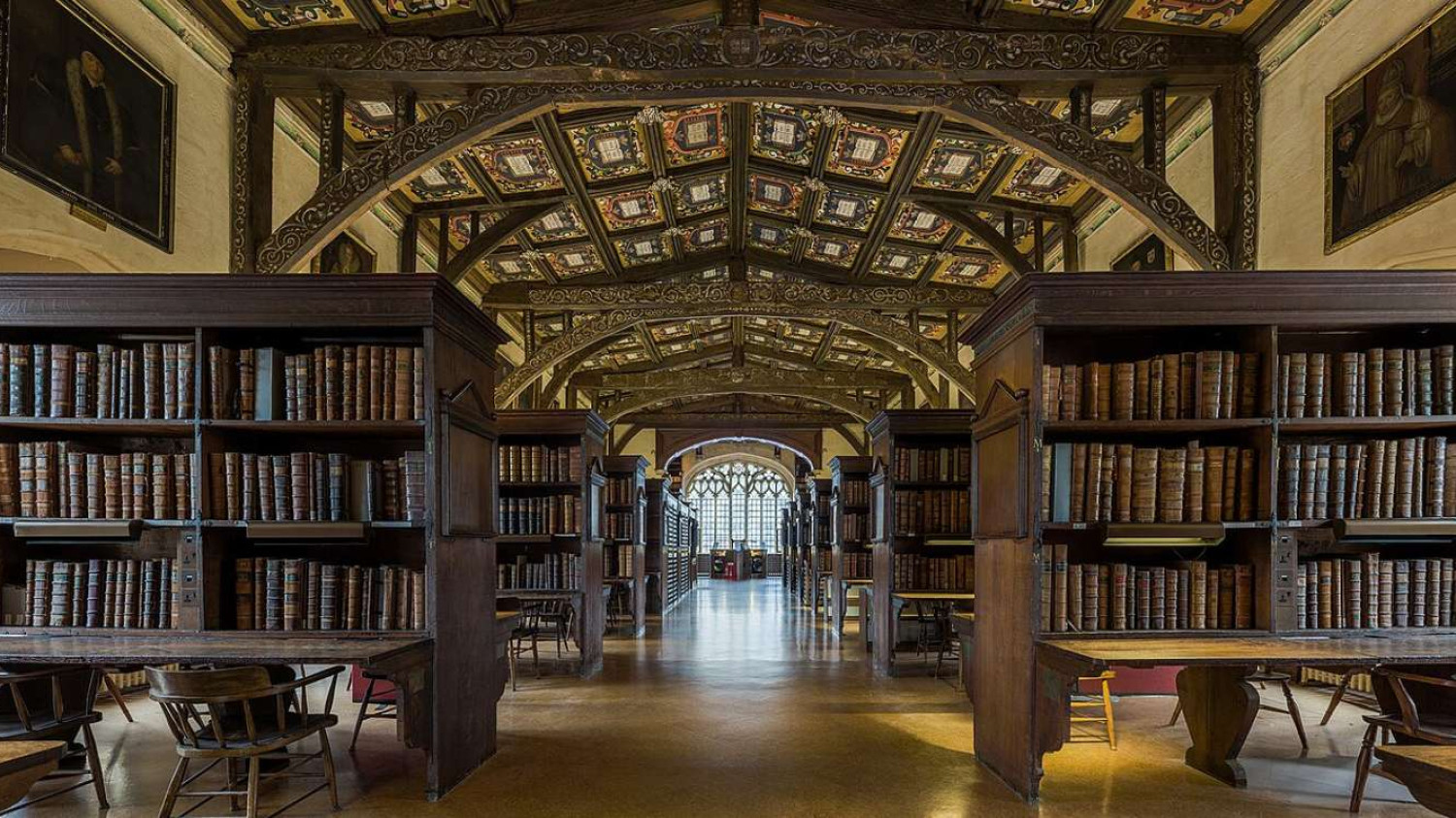
In Jane Austen’s Mansfield Park, the heroine, Fanny Price, when in Portsmouth, seeks out the local library and becomes “a renter, a chuser (sic) of books”. I cannot remember any time of my life when I did not regularly visit the local library, and I fully understand Fanny’s joy and the sense of expansion it brings to know you can enter a library and borrow any of its books. However, in Jane Austen’s day, there was no such object as a library card. In her time, paper ledgers kept track of which person had borrowed which book. This was cumbersome, as there had to be a separate page for each borrower, and what they borrowed and returned. British libraries were then private – one became a subscribing member for a fee.
In France, during the French Revolution, there was a paper shortage so the Government wrote book titles on the backs of playing cards – this created the first ‘card catalogue’.
In the 1840s a free library movement began, open to everyone. Slowly it became a more permanent practice to use some form of card system to keep track of what was being borrowed. However, writing our names and dates took time and long queues often formed in libraries as relevant pages were found and details filled in.
In 1900, at Newark Public Library, the director John Cotton Dana invented a two-card system – one card stayed in the borrowed book, while the other stayed at the library. These early cards had space to write ‘date borrowed’, ‘date due’ and ‘date returned’, so they did fill up and needed to be replaced. In 1932, also in the USA, the Gaylord Company created an electrically operated book-charging machine that used paper cards with embossed metal plates on them. This machine then stamped the borrower’s number onto a book card.
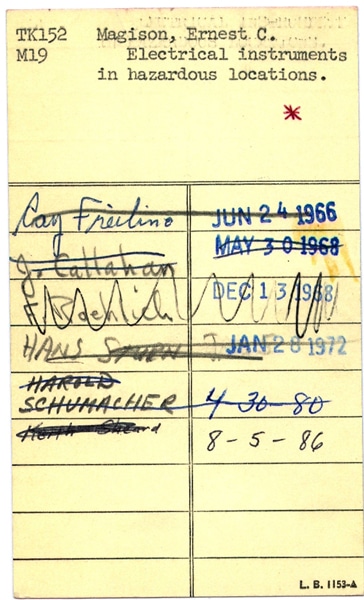
Over the following decades, other machine-operated or automated systems evolved. I must admit to feeling nostalgic about the old card system – a borrowed book would have its lending history written inside it, with crossings-out and a date history that told you much about the popularity of that book. Look at this example – a book with the thrilling title Electrical Instruments in Hazardous Locations. It was borrowed six times in twenty years, mostly (if not wholly) by men!
By the 1970s computers were taking over, and old paper and metal cards were replaced with barcodes. Plastic cards could then be scanned to be linked with the book being borrowed. Today, it is all more efficient, can be done by the borrower and saves on paper, but a part of me will always miss the old way of borrowing from a library, that most wonderful of institutions.
Are you feeling nostalgic for library borrowing cards? How often did you visit your local library? Please leave a comment.
Selected links for relevant websites, books, movies, videos, and more. Some of these links lead to protected content on this website, learn more about that here.
Helen Jakobi
Ah yes, those library cards with the name and date suggesting the shared reading history; I often wondered who that person was, did he or she enjoy the book? I loved taking my book to the counter librarian who removed the card from the inside cover, popped it into its little ‘holder’ and used her date stamp with a smart ‘click’ sound alerting us that the transaction was complete. so much more personal.
Susannah Fullerton
Now it tends to be self check-out in libraries, so one no longer chats to the librarian. Yes, I also remember the sound of the date stamp!
Julie Sweeten
Thanks for this interesting history of borrowing from libraries. One of my duties in the 1980s when I worked at the university library was to go through the card drawer looking for overdue books and sending out notices. I uncovered a very naughty student who had invented a fake identity so he could keep all the best books all term! We finally worked out his identity by comparing handwriting with the help of his lecturer.
Susannah Fullerton
That’s a great story but glad you found out who it was. I became a school librarian solely because it meant I was allowed to borrow twice the number of books as other students. Libraries are just the most wonderful places!
Penelope Morris
I too miss the old library cards. It made you feel connected to total strangers just knowing you had that book in common. A similar feeling comes through the community book libraries people place on their front fences. I have found many a great read and am grateful to whomever donated that book to be handed on to a fellow reader.
Susannah Fullerton
Yes, you always wondered about those who had borrowed before you and if they had also enjoyed or disliked the book. Far more of a feeling of connection in libraries then than there is today when everything is computerised and there’s no librarian sitting at the main desk (they are encouraged to ‘float’ around these days).
Sandra Malcolm
Very interested in the article on library cards but rather dismayed as a retired librarian that I can’t remember what system was used before computerization. I love Jane Austen’s references to libraries. Thank you for a very interesting article.
Susannah Fullerton
So glad you enjoyed it. Libraries are such important places. I remember the old cards that got stamped with the date, and the joy of carrying home a pile of books to read. No cost and such endless hours of pleasure.