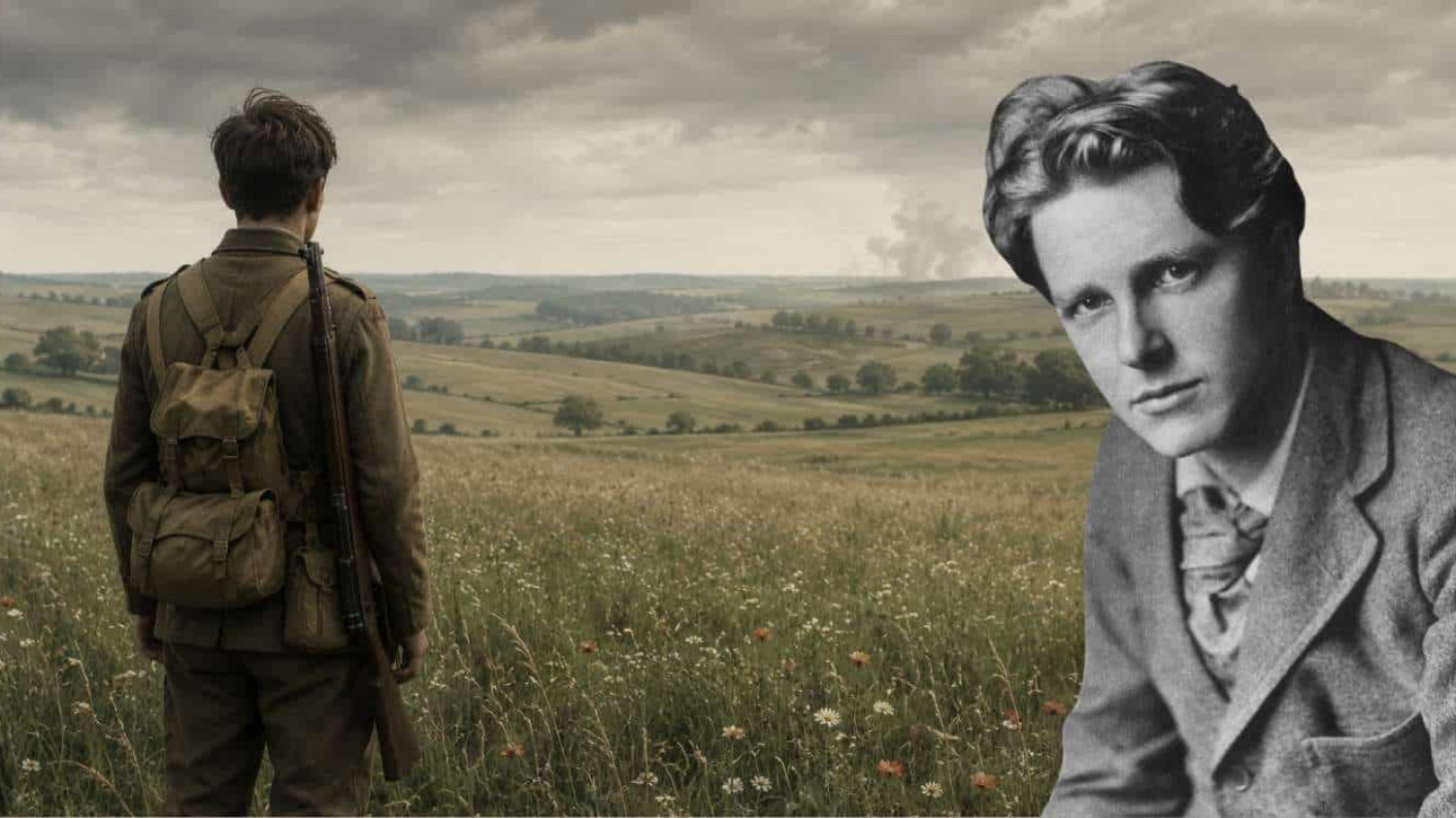
At the start of World War I, young Englishmen were filled with patriotic fervour. War seemed a mighty big adventure, and of course, they’d be home by Christmas. They had no idea of the mud, horror and destruction that awaited them in the trenches. One young man who felt he could happily die for his country was Rupert Brooke, impossibly handsome with his red-gold hair and blue eyes and blessed with poetic talent. The Soldier was written in 1914, and the manuscript is now at Brooke’s old college, King’s, at Cambridge.
The Soldier by Rupert Brooke
If I should die, think only this of me:
That there’s some corner of a foreign field
That is for ever England. There shall be
In that rich earth a richer dust concealed;
A dust whom England bore, shaped, made aware,
Gave, once, her flowers to love, her ways to roam;
A body of England’s, breathing English air,
Washed by the rivers, blest by suns of home.
And think, this heart, all evil shed away,
A pulse in the eternal mind, no less
Gives somewhere back the thoughts by England given;
Her sights and sounds; dreams happy as her day;
And laughter, learnt of friends; and gentleness,
In hearts at peace, under an English heaven.
It’s a highly idealistic sonnet and was a huge hit with the general public. Ministers read it out from their pulpits, and it was praised by most readers. The young soldier of the title sees himself as owing his identity and his happiness to England – the country is worth defending with his life, if needed. Death is not seen as a tragedy but rather as a purifying process, cleansing his soul in a baptismal way. It is a sanitised and naïve view of war, and soon the public mood changed, as the death lists grew longer, the truth of life at the front began to emerge and the war dragged on and on.
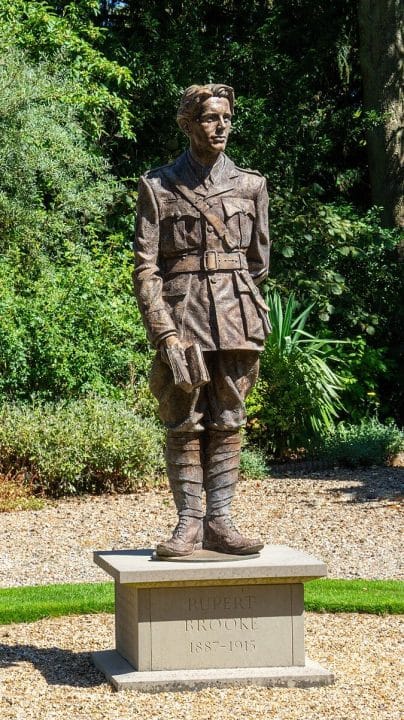
Brooke died of dysentery and blood poisoning aboard a troop ship in April 1915 – not at all the ‘romantic’ death he had envisaged. He was buried in an olive grove on the island of Skyros. His home at Grantchester, where he lived as a student and where he wrote a lot of poems, is currently the home of Lady Mary Archer (wife of novelist Jeffrey Archer). Outside the front of the house is a statue of Rupert Brooke, in his soldier’s uniform.
Here is a nice reading of it by David Barnes:
Today, the poem remains one of the most anthologised of war poems. Tell me what you think of it in a comment.
Selected links for relevant websites, books, movies, videos, and more. Some of these links lead to protected content on this website, learn more about that here.
Patty Bruniges
Such a memorable poem, particularly the first few lines which appear often.
Susannah Fullerton
It is so memorable and always makes me feel patriotic to England, even though I am not English.
Vanessa Coldwell
Compare it to Anthem for Doomed Youth and Dulce et Decorum Est by Wilfred Owen and you get a picture of war was really like. Besides, England had nothing to offer soldiers returning from the war. Many were and remained out of work and became destitute, others were shellshocked and received no help from the state- Septimus Smith in Mrs. Dalloway springs to mind.
Susannah Fullerton
Yes, so many returned, maimed and shell-shocked and felt unwanted by British society. It was all so tragic, as war is!
Penny Morris
I came to know about Owen and Sassoon after reading the first part of Pat Barker’s trilogy “Regeneration”, sober reading. Not long afterwards, I sang Benjamin Britten’s War Requiem which uses Owen’s poems and which make the choral work especially poignat. Recently I did a private tour of WWI battlefields and was made even more aware of the waste of thousands of young men. Such a tragic time in our history but has mankind learnt from it? Current world conditions would suggest not
Vanessa Coldwell
It’s well worth also reading the other two books in the trilogy.
Susannah Fullerton
Definitely!
Susannah Fullerton
I have also seen the ‘Regeneration’ film which was good, and the books are wonderful. No, I don’t think people learn from the horrors of war.
Nicole
This poem is most interesting when read in comparison to the great poetry of the late war by Owen, Sassoon etc. There is a poignancy in the naivety and that he died in the most mundane way after writing it. He was obviously a man much cherished by his friends, but the poem also reads differently in a post imperial world – is Greek soil really enriched by containing the body of an Englishman?
Susannah Fullerton
Yes, our ideas of patriotism have changed since he wrote the poem. Although I guess I would argue that soil anywhere in the world is enriched if it holds the remains of a great poet!