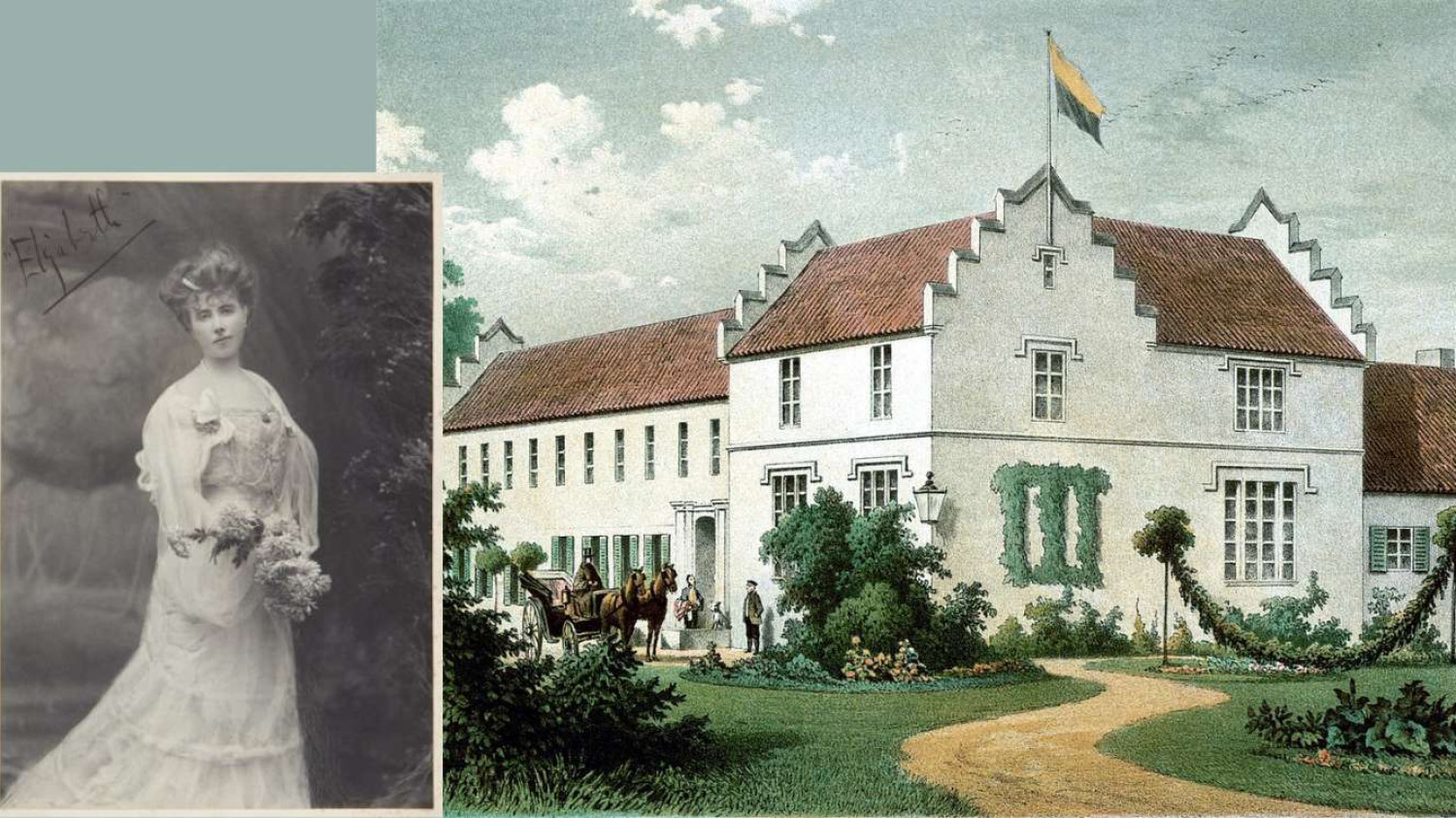
After the death of her first husband, Elizabeth von Arnim’s second marriage, to Frank Russell (brother of philosopher Bertrand Russell), was a short-lived disaster of only about six months. She quickly recovered and spent the roaring twenties with a lover more than 20 years her junior. [1]
Elizabeth von Arnim was a British-Australian novelist best known for her witty, satirical portrayals of society and the inner lives of women. Her semi-autobiographical debut, Elizabeth and Her German Garden, established her as a leading literary voice of early twentieth-century fiction.
Elizabeth, who was named Mary Annette Beauchamp, was born in Kirribilli, Sydney, on 31 August 1866, a time when the British Empire still felt vast and assured. Her father, Henry Herron Beauchamp, was a prosperous shipping merchant, and her mother, Elizabeth—known affectionately as Louey—presided over a lively household of six children. Mary Annette, called “May” within the family, grew up amid comfort, curiosity and conversation.
Her father died when May was three, and the family relocated to England. Their life was divided between London and extended stays in Switzerland, giving her an early familiarity with European landscapes and cultures. She studied at the Royal College of Music, training as an organist, although she never pursued a professional musical career. May was widely read, observant, and alert to the subtleties of social behaviour.
Family connections also shaped her intellectual world. She was closely related to the writer Katherine Mansfield, and although Mansfield was more than twenty years her junior, the two women later formed a lively, if sometimes fraught, literary friendship. They read and reviewed each other’s work, and their correspondence reveals both affection and rivalry.
In February 1891, May married Count Henning August von Arnim-Schlagenthin, a widowed Prussian aristocrat whom she had met while travelling in Italy. The marriage transported her into the formal, hierarchical world of the German landed gentry. After periods in Berlin, the couple settled at the family estate of Nassenheide in Pomerania (now Rzedziny in Poland). There, now known as Countess von Arnim, she managed a large household and raised five children.
The marriage, though initially affectionate, placed May within a rigid social structure that she found both stifling and absurd. Her frustrations were soon expressed on the page, becoming the book, Elizabeth and Her German Garden. Published anonymously in 1898, it was an immediate literary sensation. Lightly comic yet perceptive, it introduced readers to a narrative style that was intimate, ironic and refreshingly female. Significantly, the book presented her simply as “Elizabeth”—a name she would claim for herself, both as a writer and as a woman determined to shape her own story. Its success allowed her a measure of independence rare for women writers of her generation.
Over her career, she wrote more than twenty books, including Vera (1921), a dark exploration of psychological control, and The Enchanted April (1922), a tale of renewal and female friendship later adapted into film and stage works.
Von Arnim’s personal life was intertwined with literary and intellectual circles. After her first husband’s death, she had a well-known affair with H.G. Wells and later married John Francis Stanley Russell, 2nd Earl Russell, brother of Bertrand Russell. This second marriage ended in separation.
Elizabeth von Arnim died aged 74 on 9 February 1941.
Selected links for relevant websites, books, movies, videos, and more. Some of these links lead to protected content on this website, learn more about that here.
The Elizabeth von Arnim Society
Elizabeth von Arnim Society: Photographs of Rzedziny
Gutenberg: books by Elizabeth von Arnim
Elizabeth and her German Garden by Elizabeth von Arnim
Vera by Elizabeth von Arnim
The Enchanted April by Elizabeth Von Arnim
Susannah Fullerton: My 2020 Favourites
Susannah Fullerton: My 2023 Favourites
Susannah Fullerton: 100 Favourite Novels
Susannah Fullerton: I do Love a Nice Garden
Susannah Fullerton: E.M. Forster is born