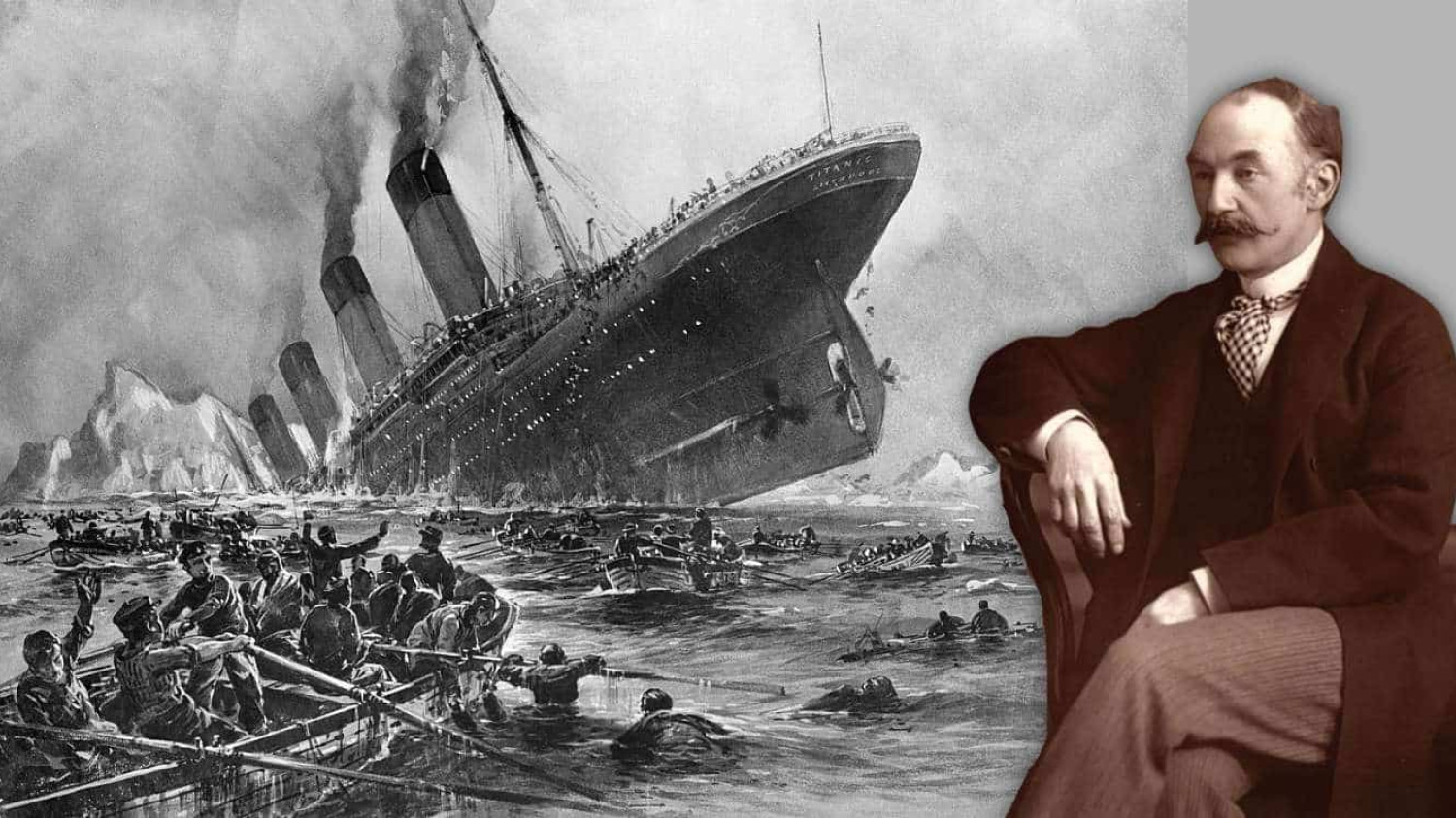
In the early hours of 15 April 1912, the Titanic sank after striking an iceberg. The news shocked everyone as the ship was supposed to be unsinkable. The great vessel had been seen as the epitome of Britain’s wealth and power.
Thomas Hardy was moved to write a poem on the occasion. Instead of focussing on the chaos and the loss, he instead chose to write of the ship and the iceberg, and their fateful meeting. The poem, The Convergence of the Twain: (Lines on the Loss of the ‘Titanic’), was published that same year.
The Convergence of the Twain: (Lines on the Loss of the ‘Titanic’) by Thomas Hardy
I
In a solitude of the sea
Deep from human vanity,
And the Pride of Life that planned her, stilly couches she.
II
Steel chambers, late the pyres
Of her salamandrine fires,
Cold currents thrid, and turn to rhythmic tidal lyres.
III
Over the mirrors meant
To glass the opulent
The sea-worm crawls — grotesque, slimed, dumb, indifferent.
IV
Jewels in joy designed
To ravish the sensuous mind
Lie lightless, all their sparkles bleared and black and blind.
V
Dim moon-eyed fishes near
Gaze at the gilded gear
And query: “What does this vaingloriousness down here?” …
VI
Well: while was fashioning
This creature of cleaving wing,
The Immanent Will that stirs and urges everything
VII
Prepared a sinister mate
For her — so gaily great —
A Shape of Ice, for the time far and dissociate.
VIII
And as the smart ship grew
In stature, grace, and hue,
In shadowy silent distance grew the Iceberg too.
IX
Alien they seemed to be;
No mortal eye could see
The intimate welding of their later history,
X
Or sign that they were bent
By paths coincident
On being anon twin halves of one august event,
XI
Till the Spinner of the Years
Said “Now!” And each one hears,
And consummation comes, and jars two hemispheres.
It has remained one of his more controversial poems. He appears to be contrasting the pride and vanity of mankind, represented by the ship, with the harshness and beauty of nature. The poem is notably missing in compassion, or even any reference to the loss of life (approximately 1,500 people died). In the first five stanzas the opulence of the ship is now gazed on by fishes at the bottom of the ocean, and there is an emphasis on the terrible waste of jewels and lavish furnishings.
In the sixth stanza there’s a shift as Hardy moves to looking at the cause of the disaster. He links ship and iceberg as the ‘Twain’, implying that the convergence of the two was predestined (Hardy was always a great believer in Fate). The convergence almost seems to have been an unavoidable event caused by some uncontrollable force (i.e. ‘The Imminent Will’, the ‘Spinner of Years’ etc). Human technology is seen as powerless when pitted against the forces of nature.
The poem offers no comfort or anyone to blame for the tragedy, but rather it leaves the reader with a strong sense of human insignificance. There is no compassion or kindness to be found in nature.
The stanzas with their long third lines, are almost shaped like the ship and the iceberg, with more below the surface than above. There is a definite separation between the stanzas, which are numbered, again stressing the idea of separate things that will be brought together by fate.
You can listen to it read here:
What do you think of this poem? Please tell me in a comment.
Selected links for relevant websites, books, movies, videos, and more. Some of these links lead to protected content on this website, learn more about that here.
Susannah Fullerton: Thomas Hardy is born
Susannah Fullerton: Thomas Hardy marries for the second time
Susannah Fullerton: Edward, Prince of Wales, lunches with Thomas Hardy
Susannah Fullerton: Thomas Hardy dies
Susannah Fullerton: Beyond the Last Lamp by Thomas Hardy
Susannah Fullerton: When I set out for Lyonnesse by Thomas Hardy
Susannah Fullerton: In Church by Thomas Hardy
Susannah Fullerton: The Ruined Maid by Thomas Hardy
Susannah Fullerton: The Convergence of the Twain by Thomas Hardy
Susannah Fullerton: Wessex, a wire fox terrier
Susannah Fullerton: Thomas Hardy’s Ale
Susannah Fullerton: The Hardy Tree
Susannah Fullerton: 5 Unpopular 19th Century Novels that Became Classics
Susannah Fullerton: Thomas Hardy: Novelist and Poet
Susannah Fullerton: Video Talk – Tess of the D’Urbervilles by Thomas Hardy
Hardy Society
Hardy’s World
Poetry Foundation: Thomas Hardy
The Guardian: Thomas Hardy
The Victorian Web: Thomas Hardy
Brett R Johnson
Thanks so much, Susannah, for this month’s poem, which I didn’t know and found strange and disturbing. Loved the reading by Ben W Smith – he really makes sense of the flow of lines, especially when there is a flow-on (enjambment) between the numbered sections. It’s time I read more Hardy.
janet
I loved your analysis of the poem. It added to my appreciation of it.
Louise Nicholas
I liked this disturbing poem. My mind went to the new Titanics, the data centres to be moored on land. How will unkind Nature deal with their creators as they suck water and energy from limited resources?
Susannah Fullerton
I also really like this poem and find it most unusual. I was interested in your speculation – we can only wonder what will happen??